AI Agents for Business: What They Do and What They Cost in 2026
What AI agents genuinely do for a small business, an honest 2026 cost picture, and a four-question scorecard for choosing the first workflow to delegate.

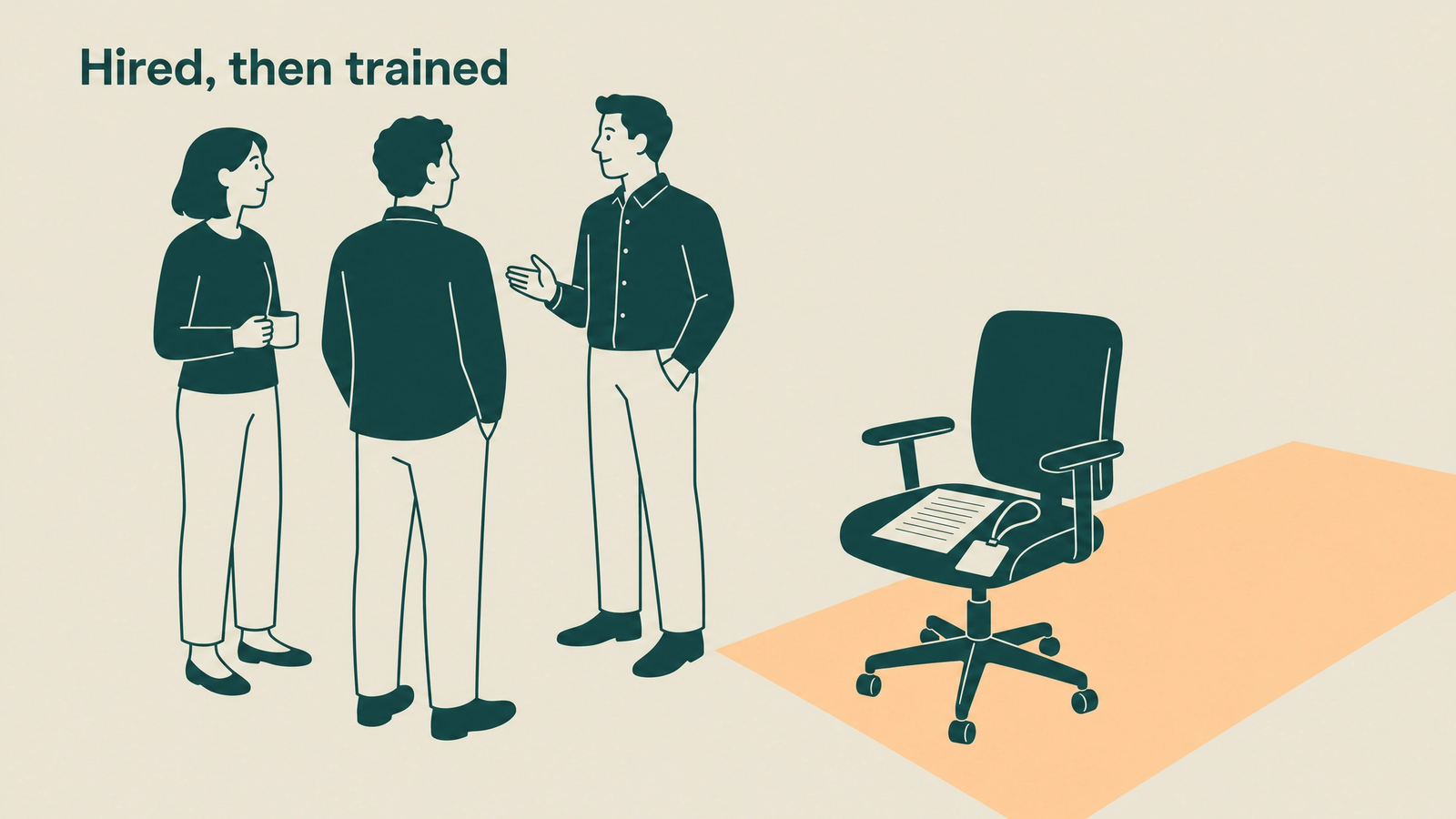
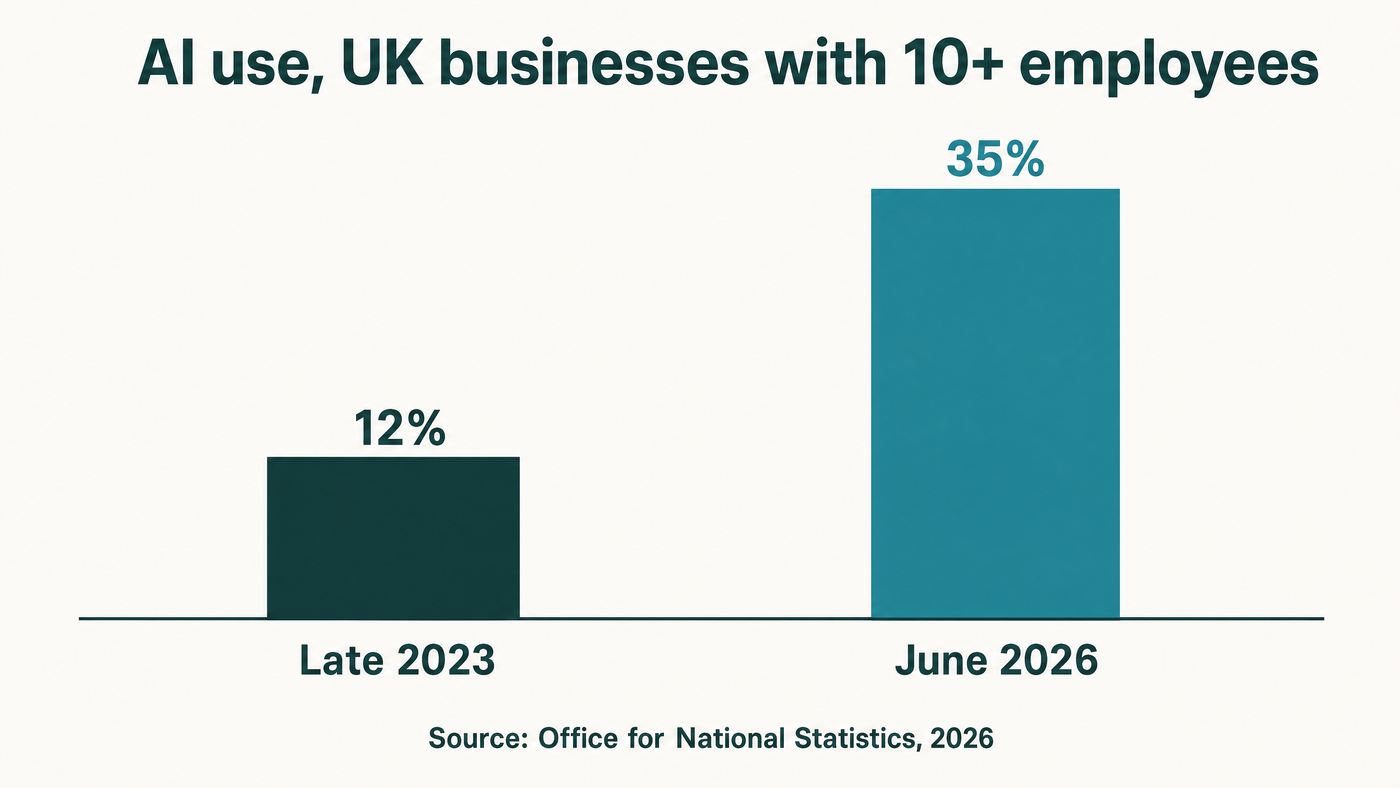
An agent reads a refund email, checks the order, and drafts the refund for your sign-off. That is what AI agents for business do in 2026: finish multi-step jobs across your tools while you approve the result. If you use an assistant most days yet still cannot say what an agent would do in your firm, blame the demos, which run on fictional companies rather than your orders and your policies. This guide covers the use cases that fit a small business, real costs, from £23.10 per user per month to a working week of set-up for a five-person firm, and a scorecard for picking the first job to delegate. The ONS reports AI use among UK businesses with ten or more employees rose from about 12% in late 2023 to about 35% by June 2026. Start with the line between an agent and the chatbot you already use.
What separates an AI agent from a chatbot?
An AI agent is software that plans and completes multi-step work across your tools, while a chatbot answers one message at a time and waits. Give a chatbot your refund policy and it will explain it back to you. Give an agent the same policy, plus access to your inbox and order system, and it will read the complaint, check the order, draft the refund and queue it for your approval. That is the ai agent vs chatbot distinction that matters commercially, because finished work is worth paying for and explanations are free everywhere.
The distinction also compounds. Once an agent completes one step reliably, you can chain steps into whole workflows, which is the logic behind compound AI work. The question stops being whether the technology works and becomes which of your workflows deserve it first.
Which AI agents use cases fit a small business?
The strongest ai agents use cases for a small business are the repetitive, rule-bound jobs that eat your week: support triage, supplier admin, sales research and reporting. In support, an agent can categorise incoming messages, answer the routine half against your policies and escalate the rest. In operations, it can chase overdue invoices, reconcile orders against deliveries and flag stock below your thresholds.
Sales and research may be the most urgent case, because your buyers moved before you did. G2's April 2026 survey of 1,076 B2B decision-makers found that 51% now start software research with an AI chatbot more often than Google, and 33% bought from a vendor they had never heard of. A research agent works the same way, splitting one question into dozens of sub-queries, the same query fan-out behaviour AI search engines use, then qualifying prospects against a sharp definition of your customer before you spend an hour on a call.
Content is one use case among these, and HubSpot's 2026 State of Marketing report finds 42.5% of marketers using AI extensively for content creation, with a further 38% using it occasionally. If that is your branch, the five-minute decision test tells you whether an agent fits, and the blog versus social question tells you where to point it. Every use case carries a price, so look at the numbers next.
How much do AI agents cost in 2026?
AI agents for small business budgets start near £20 per person per month, and the larger investment is the time you spend teaching the agent your business. Costs stack in three layers. The first is the seat: in the UK, Copilot's business tier lists at £23.10 per user per month billed annually, and Claude team seats run at $20 per seat per month, with premium seats for heavier agent workloads at $100. The second is usage, since agents that run continuously are metered and a busy month can cost double a quiet one. The third is set-up: documenting procedures, connecting systems and reviewing early output, which for a five-person firm means roughly a working week spread across the first month.
Software under £150 a month is a manageable bet for the workflows above. If the workflow is content specifically, the content cost picture runs deeper than seat prices. The spend only goes wrong when it lands on an agent that knows nothing about you.
Why does a generic agent underdeliver?
A generic agent gives every business the same competent, placeless output, because everything valuable about an agent lives in its context. This is why generic AI content reads the same everywhere: the words are fluent and the brand data behind them is missing. The same failure repeats in a support agent that has never read your policies and an ops agent that has never seen your supplier terms. Customisation carries the whole value. An agent trained on your offers, your customers, your tone and your constraints produces work you would actually ship.
Handing a trained agent ownership of one recurring workflow is the move from AI-enabled to AI-first, and that single step is the one this piece argues for. AI-native, where workflows are designed around agents from the start, can wait a year.
Apex is voholabs' expression of this argument for the content branch: a content agent trained on your brand before it writes a word. See how the training works at voholabs.com/apex.
Training an agent starts with choosing the right first job.
How to use AI agents: run the delegation scorecard
Delegate first the task you repeat weekly, could write a procedure for, and can check in under a minute. If you read the AI workflows guide, three of these questions will be familiar; scoring them 0 to 2 is what turns a yes-or-no test into a ranking. Score each candidate task on four questions:
- How often does it recur? Daily scores 2, weekly scores 1, monthly scores 0.
- Could you write the procedure down? Fully documentable scores 2, partly scores 1, pure judgement scores 0.
- How cheap is a mistake? Easily caught and reversed scores 2, awkward scores 1, costly or public scores 0.
- How fast can you check the output? Under a minute scores 2, under ten scores 1, longer scores 0.
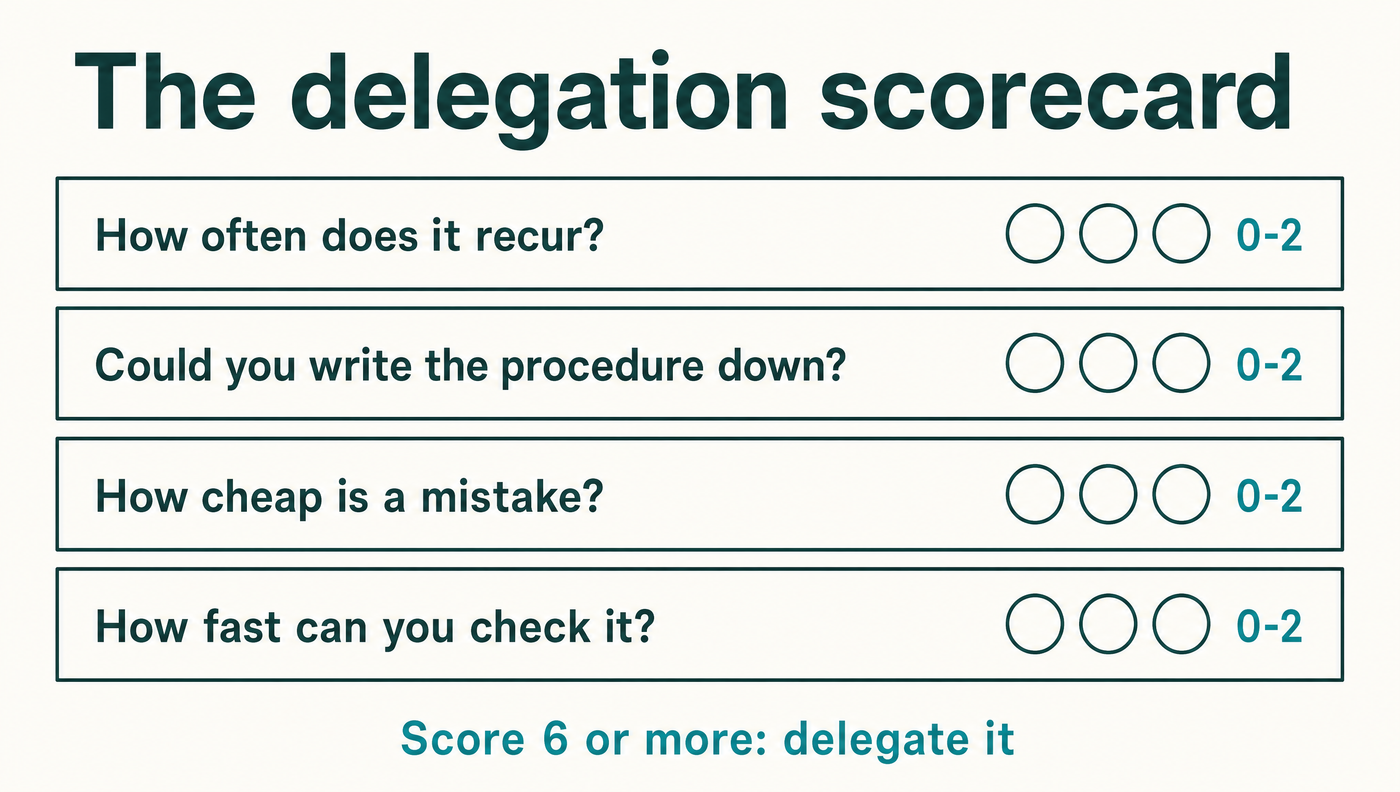
Anything scoring 6 or more is a candidate for first delegation. Invoice chasing, inbox triage and weekly reporting usually clear the bar, while pricing decisions and sensitive client emails usually do not. Starting with a high-scoring task also softens the cold start problem, because the procedure you write down becomes the agent's first training material. Choosing the job is half the set-up, and boundaries are the other half.
What guardrails does a business agent need?
Give an agent the least access its job requires, and keep a way to stop it instantly. Least privilege, the principle of granting only the permissions a task needs, means an invoice-chasing agent sees your ledger and your outbox, never your payroll. A kill switch, a single control that halts the agent immediately, matters because agents act while you are not watching. Keep a human review step on anything customer-facing for the first month, then loosen it deliberately as the agent earns trust. The full checklist sits in our guide to agent guardrails and least privilege. These controls are what make delegation safe enough to be worth doing at all.
Where this leaves you
You are AI-enabled today, and the move to AI-first is one decision wide. Pick the single workflow that scores highest on the scorecard, write the procedure down, and give a trained agent ownership of it for a fortnight with review switched on. Judge it on finished work: your materials, your voice, your customers. A generic agent loses that test and a trained one wins it, which is the whole argument of this piece run as an experiment. If the workflow you pick turns out to be content, that is precisely the job Apex was built for.
Train the agent, then trust it with more.
References
- Artificial intelligence in UK businesses: 2023 to 2026, Office for National Statistics (2026)
- G2 2026 AI Search Insight Report, G2 (2026)
- 2026 State of Marketing: Data from 1,500+ Global Marketers, HubSpot (2026)
- Microsoft 365 Copilot for enterprise pricing, Microsoft (2026)
- Claude pricing, Anthropic (2026)
Frequently asked questions
- How much do AI agents cost?For a small business, seats on the main platforms start near £20-£25 per person per month, with premium seats for heavier agent workloads around $100. High-volume or always-on agents add metered usage, and a busy month can cost double a quiet one. The larger cost is set-up: documenting your procedures, connecting your systems and reviewing early output takes roughly a working week spread over the first month for a five-person firm.
- What is the difference between an AI agent and a chatbot?A chatbot answers one message at a time and waits. An AI agent plans and completes multi-step work across your tools, such as reading a complaint, checking the order and queuing a refund for your approval. The commercial difference is that an agent produces finished work rather than explanations.
- What should a small business delegate to an AI agent first?Score candidate tasks from 0 to 2 on four questions: how often it recurs, whether you could write the procedure down, how cheap a mistake is, and how fast you can check the output. Anything scoring 6 or more is a good first delegation. Invoice chasing, inbox triage and weekly reporting usually clear the bar; pricing decisions and sensitive client emails usually do not.
- Do AI agents need supervision?Yes, especially early on. Give an agent the least access its job requires, keep a kill switch that halts it instantly, and hold a human review step on anything customer-facing for the first month. Loosen the review deliberately as the agent earns trust, rather than removing it on day one.
Sources
- Artificial intelligence in UK businesses: 2023 to 2026· Office for National Statistics
- G2 2026 AI Search Insight Report· G2
- 2026 State of Marketing: Data from 1,500+ Global Marketers· HubSpot
- Microsoft 365 Copilot for enterprise pricing· Microsoft
- Claude pricing· Anthropic