SEO Content at Scale in 2026: 7 Ways Ranked by Cost Per Article
SEO content at scale runs from £2 to £4,467 an article. Seven routes ranked on live 2026 pricing, with the maths and every assumption shown.


By Sepehr Sanaee, July 2026, 7 min read
Twenty SEO articles a month costs around £300 on the cheapest route and around £22,000 on the dearest, and both end with a live post on your site. Budgets for SEO content at scale get set from a monthly price, when the figure that puts seven very different routes on one line is cost per published article. This piece ranks all seven against the live pricing of every named provider as of July 2026, shows the arithmetic, and states every assumption so you can drop in your own volume and rates. Some of the cheap routes are genuinely cheap. Others look cheap because your own hours never reach the invoice.
How do you work out cost per published article?
Cost per published article is total monthly spend divided by the posts that actually go live, with human time priced in. It absorbs the volume, length, and unpaid-effort differences which make headline prices incomparable, so a £37 tool and an £8,000 retainer land on the same line.
Four assumptions run through every number below. Change them and the ranking moves, which is why this is worth running on your own figures.
- Twenty published articles a month, around 1,500 words each: 30,000 words of finished copy.
- Published means live on your site, not in a drafts folder. Any route that stops at raw text carries the cost of whoever formats it, adds the internal links, and hits publish.
- Human time at £40 an hour for editing and £60 an hour for your own operator time.
- Dollar prices converted at £1 = $1.34, mid-market on 17 July 2026, rounded.
Six of the seven quote a price and leave the publishing labour with you. That gap between sticker and total decides the ranking, and how a content engine gets chosen.
What do the seven routes cost per published article?
Ranked cheapest to dearest, at twenty articles a month, with an honest note on when each one is the right answer.
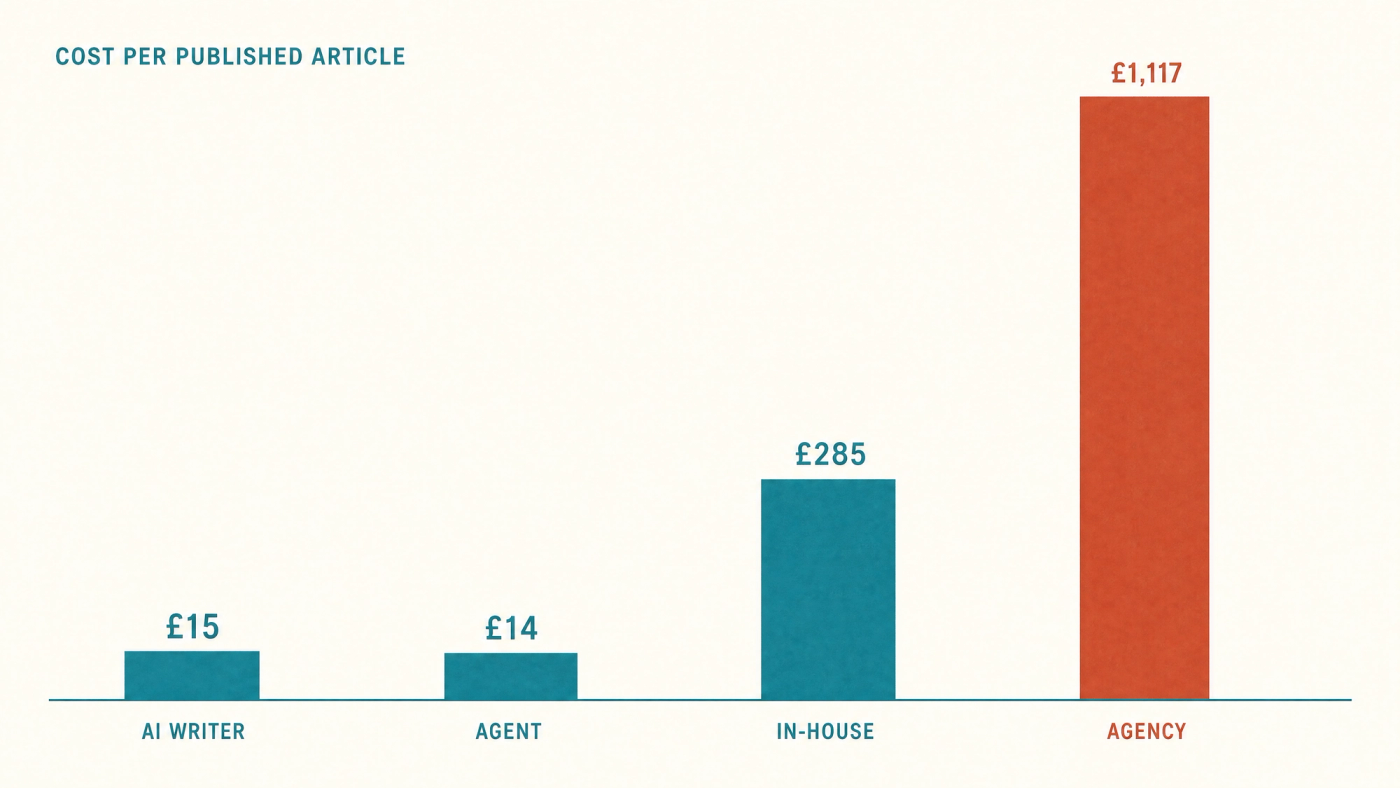
- 1. DIY AI writer (Byword, Koala), £2 software and about £15 with a human pass. Best when you have an editor's eye and seven spare hours a month.
- 2. Custom content agent (Apex), £14 in year one and £12 after. Best when you want volume and voice control with nobody on your side running it.
- 3. AI writing platform (Jasper), £3 software and about £63 with your hour. Best when content is one of several jobs the platform does for your team.
- 4. Marketplaces and freelancers (Verblio), £69 to £503. Best when volume is spiky and you would rather not carry fixed cost.
- 5. In-house writer in the UK, £171 to £285. Best when subject depth and institutional memory outrank throughput.
- 6. Optimisation tool plus a writer (Surfer, Frase, Clearscope), £283 to £508. Best when you are fighting for competitive head terms and the brief has to be right.
- 7. Agency retainer (Brafton, Siege Media), £1,117 to £4,467. Best when the article is a flagship asset carrying original research or design.
Which routes are priced by software?
The software-priced routes cost single-digit pounds per article and then bill you in time instead of money.
DIY AI writers. Koala sells its Professional plan at $49 a month for 100,000 words, so 30,000 words of copy fits comfortably: $49 across twenty articles is $2.45, or about £2. Byword starts at $99 a month on the same model. A twenty-minute editing and publishing pass at £40 an hour adds £13, taking the honest figure to roughly £15 and costing seven hours a month. Generic output is the standing risk, with a known cause: the model holds no fixed picture of your brand, so everything reads the same.
AI writing platforms. Jasper is $69 per seat per month, or $59 on an annual contract, which is £3 an article at this volume. Jasper is a marketing platform rather than a bulk article generator, so the honest number adds an hour of your own time per piece to brief, steer, and publish. At £60 an hour that is £63, and genuinely better than the DIY route if your team also needs brand voices and campaign assets from one subscription.
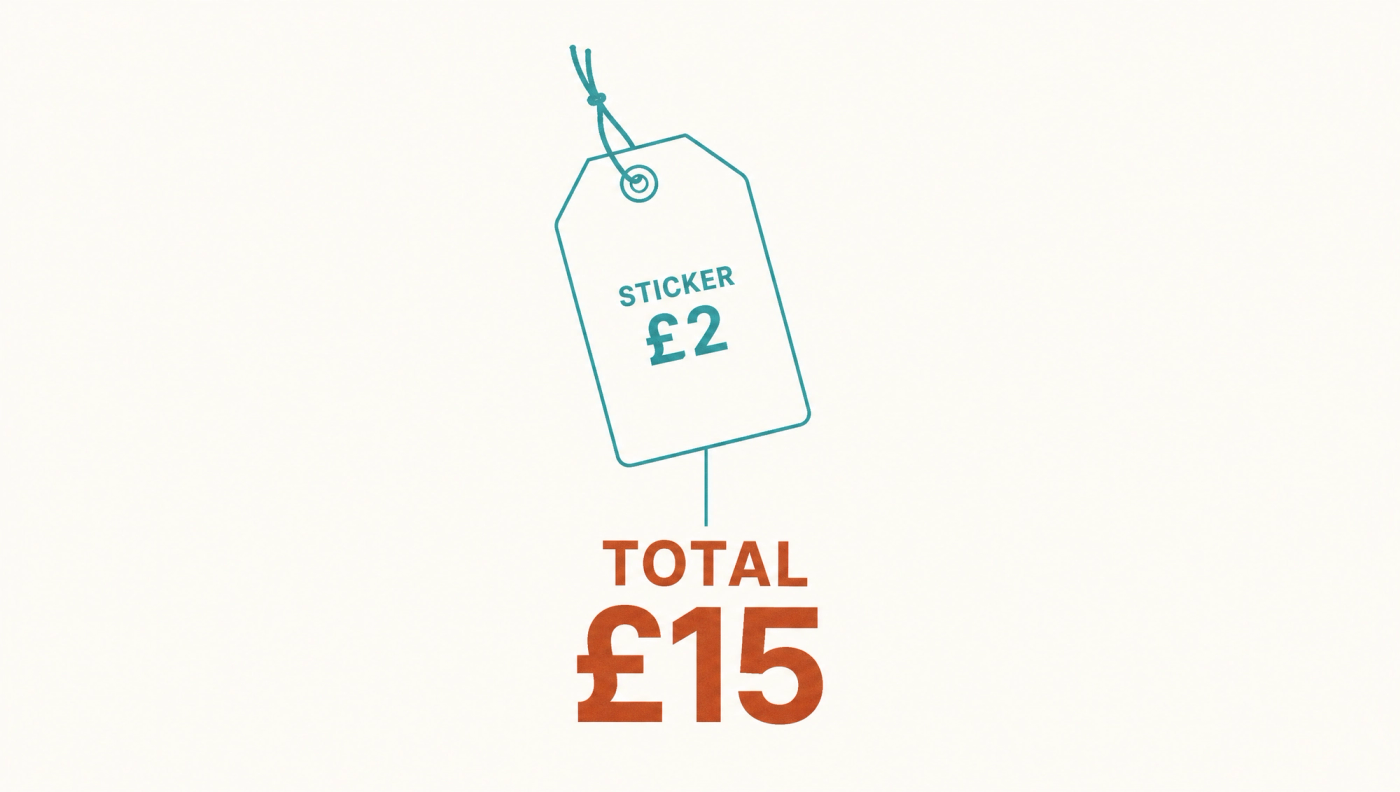
The key difference is: DIY tools and platforms sell capability, not published articles. Everything between the generated draft and the live URL stays on your desk, which is where £2 becomes £15 and £3 becomes £63.
Which routes are priced by human hours?
The human-priced routes run £69 to £508 an article, and the spread follows who is writing.
Marketplaces and freelancers. Verblio charges $0.06 a word for AI-plus-human content and $0.16 a word for fully human writing, against a $49.50 monthly platform fee on the AI plan. A 1,500-word post therefore runs $90 or $240, which is £69 and £179. Hiring direct costs more: the Editorial Freelancers Association 2026 rate chart, drawn from over 1,100 members reporting their 2025 work, puts blog post writing at 25 to 45 cents a word, so £279 to £503 for the same length.
An in-house writer. Talent.com puts the average UK SEO content writer at £34,500 a year across 10,000 salaries. Add employer National Insurance at the 15% rate, pension, and tooling and the loaded cost nears £41,000. A strong writer publishes twelve to twenty articles a month: £171 to £285 each. Nobody else on this list learns your product the way that person does.
Optimisation tool plus a writer. Surfer is $99 a month on annual billing, Frase $129 for forty articles, Clearscope $129 for Essentials. At twenty articles the tool costs £4 to £5 a piece, but it does not write, so a freelancer sits on top: £283 to £508 all in. The stack earns that premium on competitive head terms, and it is the only human route with structured coverage for AI answer engines built into the brief.
What does an agency retainer actually buy?
An agency retainer is the dearest route per published article by roughly two orders of magnitude, and it buys something the others cannot.
Brafton prices SEO content creation at $1 per word, so a 1,500-word article is $1,500, or £1,117. Siege Media states that a high-impact blog post costs $1,500 to $6,000 once research, original visuals, and expert editing are included, which is £1,117 to £4,467, and puts a working campaign for a mid-sized business at $10,000 to $20,000 a month. Verblio sits far below both because its managed service is a marketplace at heart rather than a strategy retainer.
Twenty articles a month at Brafton's rate is £22,340, and that number is not an indictment. An agency buys original research, commissioned design, and a strategist who argues back, which a flagship asset is worth paying for. Running your whole calendar through one is where the maths stops working.
Where does a custom content agent fit?
A custom content agent is its own category: an agentic service that researches, writes, and publishes into your CMS on a schedule, with nobody on your side operating it.
Apex is £799 to set up, which includes the first month, then £239 a month. At twenty published articles that is £11.95 in steady state and £14.28 across a first year including setup. The published cadence starts at three pieces a week and ramps to daily, so the twenty-a-month baseline sits inside it. Setup covers the engine in your CMS, voice calibration against your existing content, topic discovery, and the visuals, and none of it returns to you as a weekly task.

Please note: Apex is cheaper than an agency retainer by a factor of roughly eighty, and it is not cheaper than a DIY tool. Byword and Koala will always beat it on software cost. The comparison worth making is against your own hours and against a retainer, not against a subscription you still have to drive.
Apex is calibrated on your published work rather than shipped as a shared preset, which is the same reason a custom agent beats a templated platform at similar monthly cost, and why the output is built to be cited by AI answer engines rather than only ranked.
Book a 20-minute Apex walkthrough. We map your niche, show the cost per published article on your actual volume, and tell you honestly if a cheaper row fits you better. voholabs.com/apex
Which row fits the state you are in?
If you draft with an AI tool, publish when there is time, and cannot point to a month where the calendar held, you are AI-enabled: the tools are open, the output does not compound. AI-first is a pipeline that publishes whether or not you are in the room, and the move between them is arithmetic rather than a purchase.
Take last month. Count the posts that went live, add your subscriptions, add the hours anyone spent turning text into a URL at their real hourly cost, and divide. A DIY route measured this way usually lands at £60 to £90 an article in unbilled time. Once that number is honest, the ranking above sorts itself and the economics of an owned content asset become a decision rather than a guess.
Where this leaves you
Seven routes to SEO content at scale, one comparable figure, an eighty-fold spread between cheapest and dearest. The top rows bill you in hours and the bottom rows bill you in pounds, so the only honest ranking prices both. Work out your own cost per published article before you renew anything.
Voholabs builds Apex for brands that want the volume of the cheap rows with the voice control of the dear ones, published on a schedule that does not depend on you. If another row suits your volume, we will say so. Run the numbers first.
References
- SEO Plans and Pricing, Brafton (2026)
- How Much Does Content Marketing Cost in 2026?, Siege Media (2026)
- Pricing, Verblio (2026)
- Pricing, Koala (2026)
- Pricing, Byword (2026)
- Pricing, Jasper (2026)
- Pricing, Surfer SEO (2026)
- Pricing, Frase (2026)
- Pricing, Clearscope (2026)
- 2026 Rate Chart, Editorial Freelancers Association (2026)
- SEO Content Writer Salary in the United Kingdom, Talent.com (2026)
- National Insurance rates and categories, GOV.UK (2026)
- Apex, Voholabs (2026)
Frequently asked questions
- What is a realistic cost per published SEO article in 2026?It ranges from about £2 to £4,467 depending on the route. A DIY AI writer costs roughly £15 an article once you price the editing pass, a UK in-house writer £171 to £285, and an agency retainer £1,117 to £4,467 on Brafton and Siege Media's published rates.
- Is a content marketing agency ever worth the cost per article?Yes, for flagship assets. An agency retainer buys original research, commissioned design, and a strategist who pushes back, which is worth paying for on a piece meant to earn links and citations. It stops making sense when it is funding your whole publishing calendar.
- Are AI writing tools genuinely cheaper than hiring a writer?On software cost, clearly. Koala's Professional plan is $49 a month for 100,000 words and Byword starts at $99, against £279 to £503 for a freelance 1,500-word post at Editorial Freelancers Association rates. The gap narrows once you cost the editing and publishing time the tool leaves with you.
- How is a content agent different from an AI writing tool?A tool hands you a draft and leaves the rest of the job on your desk. A content agent is an agentic service that researches, writes, and publishes into your CMS on a set schedule, calibrated to your brand voice, with nobody on your side operating it day to day.
Sources
- SEO Plans and Pricing· Brafton
- How Much Does Content Marketing Cost in 2026?· Siege Media
- Pricing· Verblio
- Pricing· Koala
- Pricing· Byword
- Pricing· Jasper
- Pricing· Surfer SEO
- Pricing· Frase
- Pricing· Clearscope
- 2026 Rate Chart· Editorial Freelancers Association
- SEO Content Writer Salary in the United Kingdom· Talent.com
- National Insurance rates and categories· GOV.UK