Generic AI Content: Why It All Reads the Same (And the Fix)
Generic AI content reads the same because it runs on the same models with no brand data. The one fix is training it on your own voice.


Feed ten brands the same keyword and the same AI model, and you get back ten articles that could swap bylines without anyone noticing. Same structure, same hedged tone, same three subheadings a model reaches for by default. That is generic AI content, and it is the natural output of running everyone's request through the same system. The fix is not a better prompt. It is a different input: your own voice and your own data, fed to a system that writes for one brand only. This piece is about why the sameness happens, and the single change that ends it.
Why does generic AI content all read the same?
Generic AI content reads the same because it has no proprietary input: the same models, prompted the same way, on the same keyword, return the same shape. A model trained on the open web converges on the average of everything it has read, and a bare keyword brief gives it nothing that belongs to you. Templated platforms make this sharper by design. Outrank's roughly $99 plan applies one proven structure to every customer's 30 articles a month (Outrank, 2026). The template is the product, so the output is built to look like the template, across every brand that buys it.

What does brand-trained content actually mean?
Brand-trained content is content written by a system that has learned one brand's voice from its own published work, not from a shared template. The input that matters is your corpus: how you phrase things, what you believe, the examples you reach for, the words you never use. A system given that writes as you, because it has seen you. Apex works this way: it learns voice from your existing content and publishes into your own CMS for a £799 setup and £239 a month (Voholabs, 2026). The point is not the automation. It is that the writing carries a fingerprint a competitor cannot copy from the same model.
The key difference is: generic content is what the model already knows, while brand-trained content is what only you know, written in your voice.
How do you tell generic from brand-trained?
The test is reattribution: if a competitor could publish your article unchanged, it was generic. Read a draft and ask whether a rival in your space could put their logo on it and lose nothing. If they could, the model wrote it, not your brand. Brand-trained content fails that test in your favour, because it names your specific buyer and the need they are in, your real positions, and your own examples. That specificity is also what builds credibility before a buyer ever calls.
The one input that fixes it
The single change that ends sameness is feeding the system your own data and direction, not writing a sharper prompt. A better prompt still draws on the same shared knowledge every competitor can reach. Your published work, your decisions, and your voice are the only inputs a rival does not also have. Hand those to a content agent built for one brand, and the output becomes yours by construction, not by editing. That is the whole of it: the noise is the generic model output anyone can produce, and the signal is the proprietary input only you hold. It is also why the result compounds into an owned asset rather than blending into the feed.
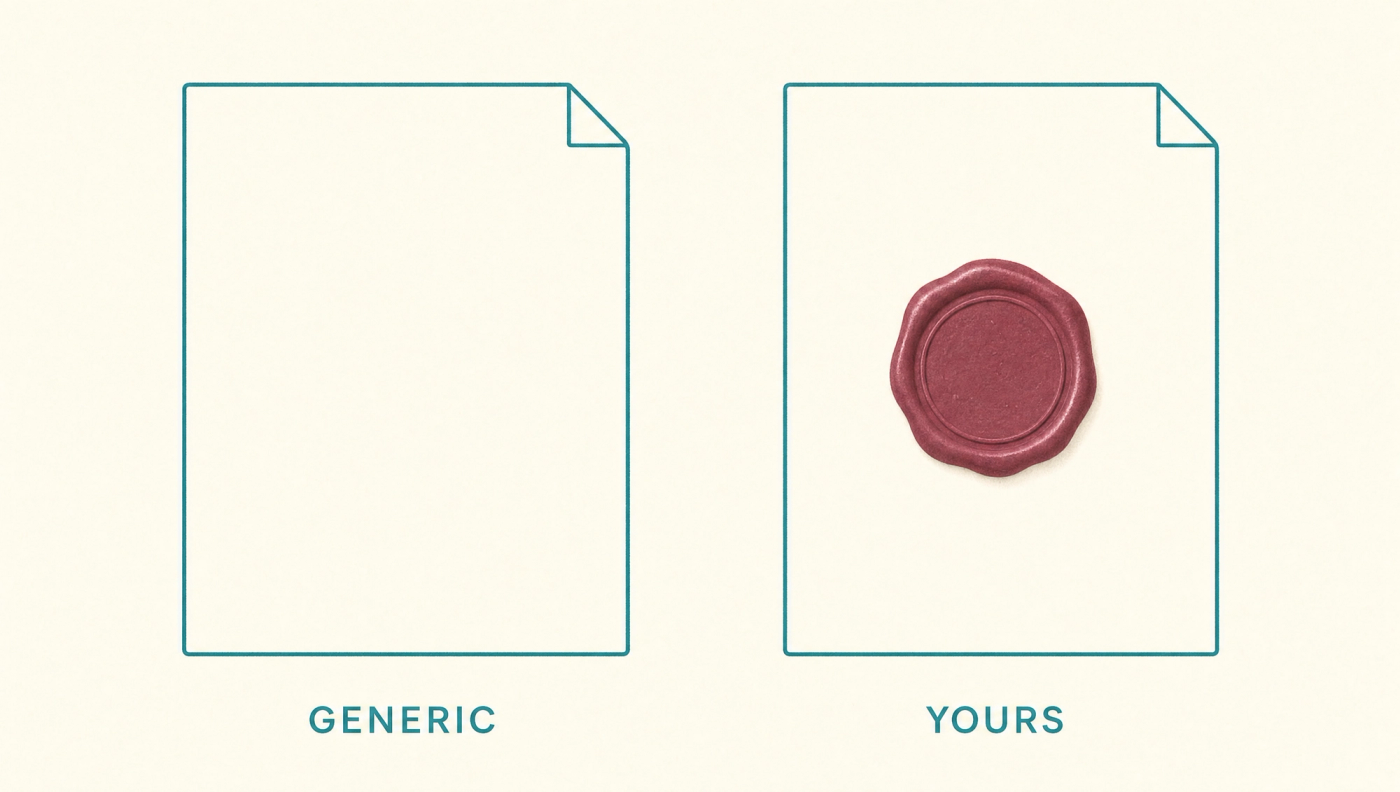
Please note: a template can still rank. It just cannot be uniquely yours, and in a market full of the same template, being uniquely yours is the part that earns trust.
Tired of content that could carry anyone's logo?
Apex learns your voice from your own published work and writes only for your brand, published straight into your CMS.
See how Apex works
Where this leaves you
Generic AI content is not a quality problem you fix with a cleverer instruction. It is an input problem. The same models and the same templates give everyone the same average, and the only way out is to feed the system something a competitor cannot: your voice, your data, your direction. Do that, and the content stops sounding like the tool and starts sounding like you. Skip it, and you are publishing the same article as everyone else who bought the same template.
Generic is the default. Yours is a choice.
References
Sources
- Outrank· Pricing and product