AI Content Skills: How to Explain Things Simply With AI
Part 6 of the AI content skills series: five ways our AI explained badly, the note that fixed each, and a Claude skill that teaches one thought completely in everyday words.


AI content skills start with a plain test: can an explainer written by AI get a total stranger from zero to understanding in one line? Most AI explainer content fails that test in the same five ways.
An AI explainer opens with a table instead of a sentence, dives into detail before the concept, names a term it never defines, cuts the thought to hit a fixed length, and reaches for jargon where a plain word exists. None of these are style points. Each one is a place where the reader stops understanding and the AI keeps talking anyway. Below are five real review notes we gave our own AI while it was teaching something, each one shown before and after, and a Claude skill that teaches one thought completely every time.
What this series is
This article is part of the AI content skills series. Everything we publish goes through an AI agent first, then through a human review. These five notes are the corrections that keep repeating, written down and turned into a skill you can install. The idea of saving a fix as a file is covered in 166 ready-made skills that turn any AI into a specialist.
The 5 mistakes AI explainer content makes
1. A table where a sentence belongs
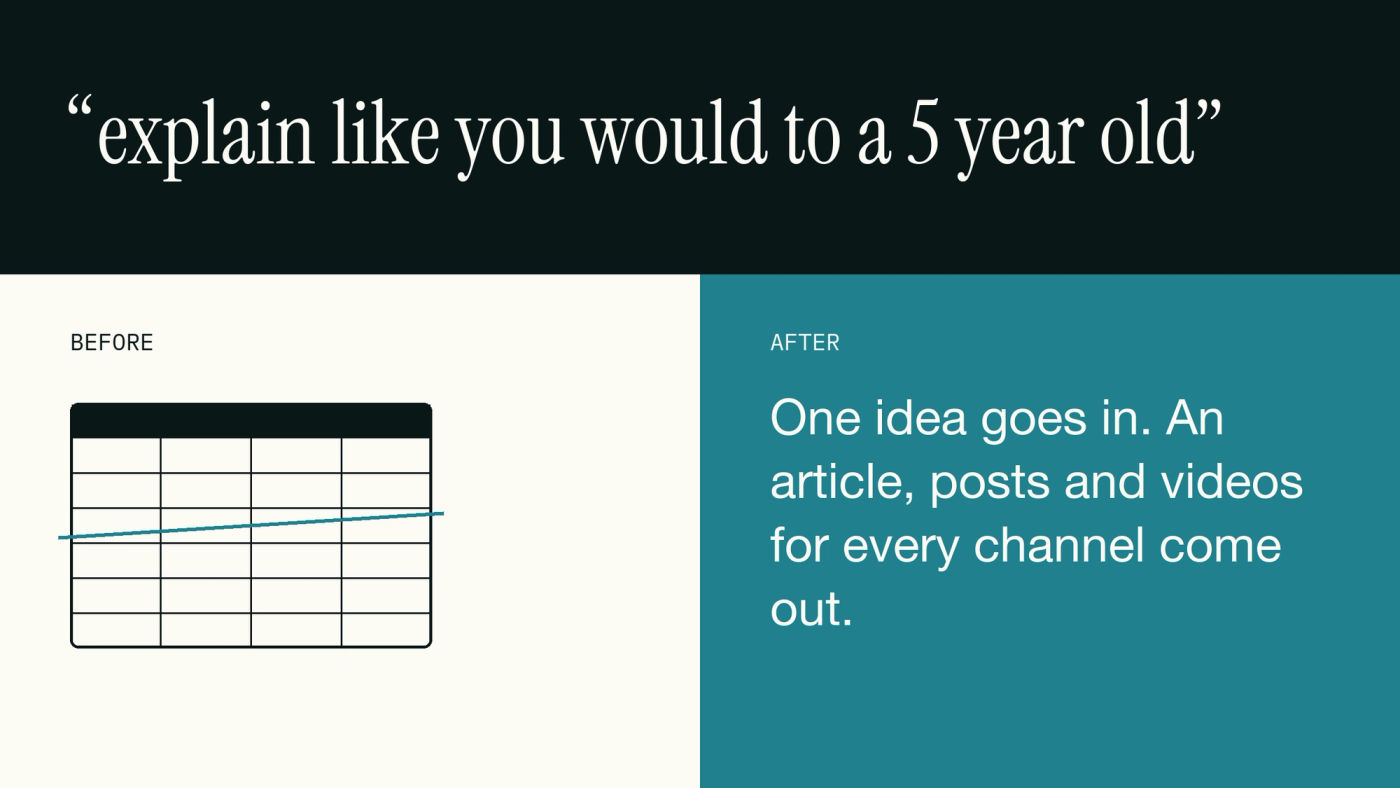
One line first, like I am 5. Before any table, list or diagram, one plain sentence has to carry the whole idea on its own.
2. Detail before concept
Concept before detail. The order is what it is, why it exists, then how it works. The batch got rebuilt from the basics before a single mechanic was mentioned again.
3. A term with no definition
Every named term earns three things in the same piece: what it is, why it matters, and how it works or how you stop it. Skip any one and the reader is left holding a word.
4. Cut to hit a duration
Length follows the idea, not a clock. If a thought needs 45 seconds it gets 45 seconds. Cut a second idea instead of cutting the first one short.
5. Jargon over everyday words
Everyday words beat correct-sounding ones. If a word would not come up at dinner, swap it for one that would.
The Claude skill
The five fixes above are now a Claude skill called explain-simply. Install it once and it runs the same checks on anything you are writing to teach.
mkdir -p ~/.claude/skills/explain-simply
# paste the SKILL.md below into ~/.claude/skills/explain-simply/SKILL.md
# then in Claude Code: /explain-simply  (or just ask it to draft; the description triggers it)
---
name: explain-simply
description: Use when writing or reviewing anything that teaches a concept: explainer posts, scripts, slides, docs, onboarding, a definition inside an article. Enforces one-line-first, concept before detail, what-why-how for every term, complete thoughts and everyday words. Triggers on explain, explainer, teach, what is, how does, definition, script, tutorial.
---
# explain-simply
Write for someone who knows nothing about the topic and has no patience. Return the explanation, then the self-check.
## Rules
1. One line first, like I'm 5. Before any table, list or diagram, one plain sentence that carries the whole idea ("One idea goes in. An article, posts and videos for every channel come out.").
2. Concept before detail. Order: what it is, why it exists, then how it works. If the draft starts inside the mechanics, rebuild it from the basics.
3. Every named term gets what, why, how. Never name a term (Sybil attack, MCP, GEO) without saying what it is, why it matters and how it works or how it is stopped, in the same piece.
4. Finish the thought. Length follows the idea. Never cut an explanation to hit a duration or a word count; cut a second idea instead.
5. Everyday words. "Set up a schedule" not "write a script"; "ask the AI" not "prompt the model". Replace any word the reader would not use at dinner.
## Self-check
- Read only the first line: does it carry the idea alone?
- List every term used: does each have what, why, how in this piece?
- Is there exactly one thought, taught to its end?
- Count words a non-specialist would not use: rewrite each.
- Would a five-year-old repeat the first line? Would a busy adult keep reading the second?
Run it on the last thing you published.
Where this leaves you
Explaining well is an order of operations: say the idea in one line, teach the concept before the detail, define every term, finish the thought, use everyday words. None of the five fixes above needed a cleverer model, only a rule applied every time. Install the skill and run it on the next thing you have to teach. Voholabs Studio is the free scheduler and MCP where we run these checks before a draft goes out.
Frequently asked questions
- What is the AI content skills approach to explaining something simply?Say the idea in one sentence a five-year-old could repeat. Then say why it matters. Then say how it works, defining every term the first time you use it.
- How long should an AI-written explainer be?As long as the thought takes, and no shorter. Never cut an explanation to hit a duration or a word count. If it needs to be shorter, cut a whole second idea, not the ending of the first one.
- What is the what-why-how rule for explaining a term?Every term you name gets three things in the same piece: what it is, why it matters, and how it works or how to stop it. Naming a term without any of the three leaves the reader stuck.
Sources
- Equipping agents for the real world with Agent Skills· Anthropic
- Creating Helpful, Reliable, People-First Content· Google Search Central