Content Repurposing in 2026: The Second Multiplier (And the 1-Test Gate)
Content repurposing is one of two multipliers, not the whole system. Here is the second one, how the two compose, and the deletion test that keeps both honest.


Gary Vaynerchuk posted 397 pieces of content in a single day. Asked how, he named two axes: platforms and handles, meaning the number of places he publishes multiplied by the number of separate accounts he publishes from.
Content repurposing, the practice of taking one finished asset and adapting it into smaller derivative pieces, scales the first of those axes. It is genuinely good at that, and it is how you get full value out of anything expensive to produce. What it cannot do alone is scale the second axis. The practice that does is non-linear content generation: many original pieces produced in parallel from one shared narrative, none cut down from another. You want both. This piece defines the second multiplier, shows how the two compose, and hands you the test that keeps the combined output honest.
What is content repurposing, and what does it multiply?
Content repurposing is the practice of taking one finished asset and adapting it into smaller derivative pieces for other channels. Vaynerchuk describes the mechanic plainly on his own site: his team "repurpose that one piece of content into dozens of smaller pieces of content, contextual to the platforms that we distribute them to". One keynote became more than 30 pieces and over 35 million views.
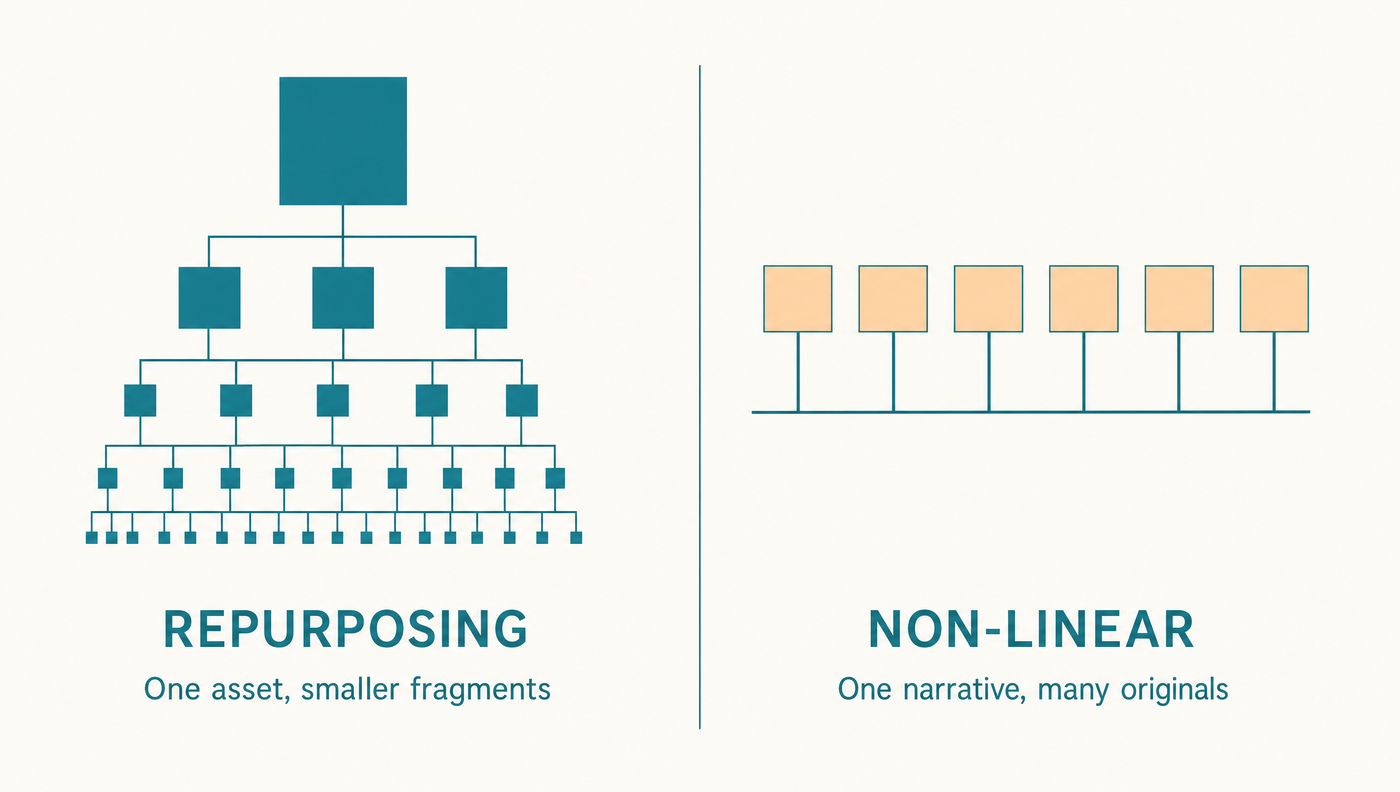
The shape of that is a pyramid. A pillar sits at the top and everything beneath it is a derivative, each piece smaller and further from the source than the one before. The logic was economic rather than creative. When an original cost hours of a writer's time and a clip cost minutes of an editor's, fragmenting was the only affordable route to volume.
The ceiling arrives when repurposing is asked to carry the volume on its own. Every derivative traces back to the same asset, so pushing that single multiplier harder makes a feed read as one argument said eight ways. Someone following two of your accounts meets the same keynote twice. The technique is not the problem; asking it to do a job that needs two multipliers is.
What is non-linear content generation?
Non-linear content generation is the production of many original pieces in parallel from one shared narrative, where no piece is derived from any other. The narrative is the position you are arguing over a given period. The pieces are siblings rather than children: each one is written natively for its own account, platform and angle, and nothing is cut down from anything else.
Put the two shapes side by side and the difference is structural. Repurposing runs downward from a single source, so the value of each piece decays with its distance from the pillar. Non-linear generation runs sideways from a shared position, so every piece carries full weight and the only thing any two of them hold in common is the argument.
Cost is the reason the second multiplier was not already standard. Eight original pieces used to cost eight times what eight clips cost, which made fragmenting the rational choice for any team without a newsroom. Production cost per published piece has fallen far enough that the calculation has changed, and once an original costs roughly what a fragment costs, the second multiplier becomes affordable to run alongside the first.
Why does volume still decide who grows in 2026?
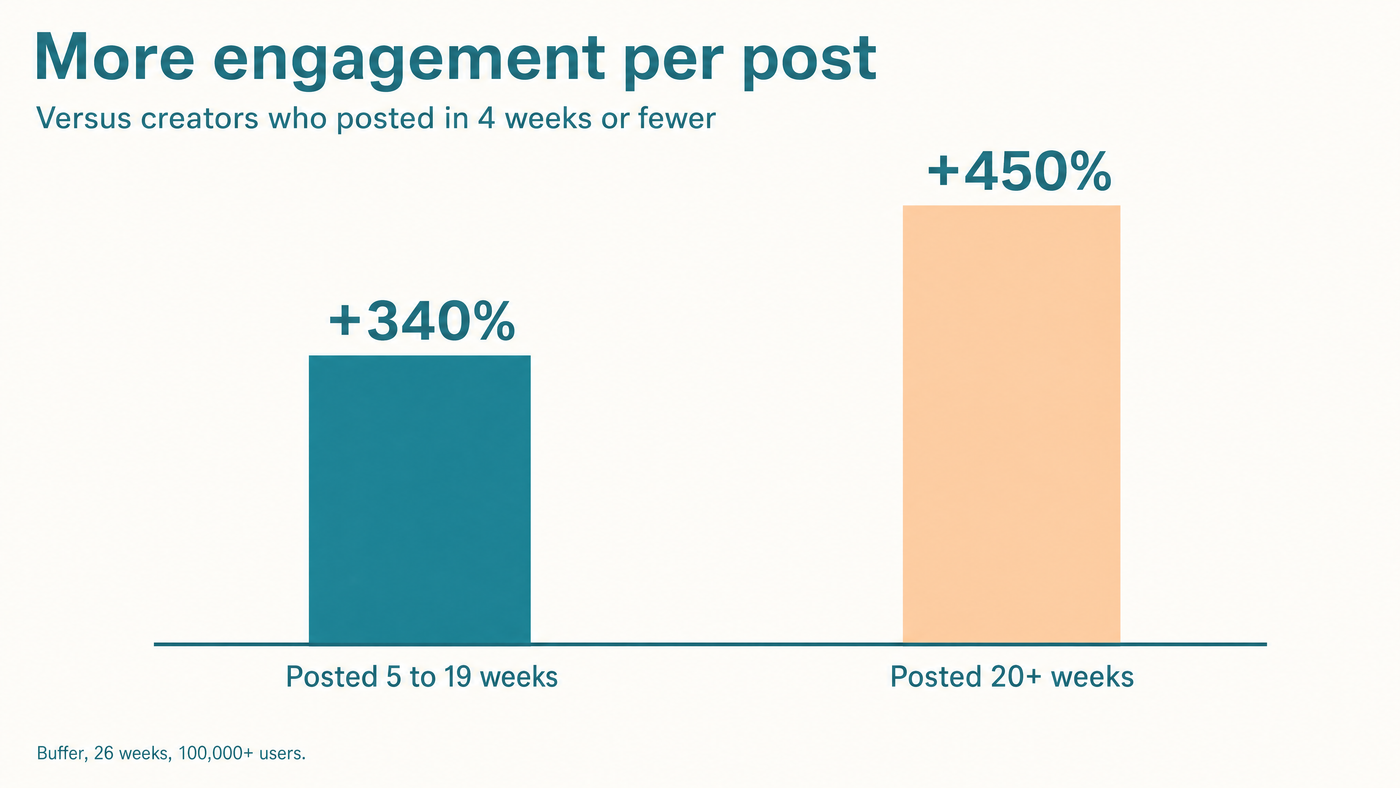
Volume remains the strongest single lever on social growth, and the 2026 data is not ambiguous. Buffer analysed 26 weeks of posting behaviour across more than 100,000 users and found that creators who posted in 20 or more of those weeks earned roughly 450% more engagement per post than creators who posted in four weeks or fewer. That figure is measured per post, so the additional volume did not dilute the average, it raised it.
Alex Hormozi's phrase for the same finding is that volume negates luck, and he is direct about the algorithmic half: no algorithm penalises volume, because a platform is incentivised to show good things to more people. In his own 2026 breakdown of how he produces content he gives the middle ground a name, qualium, which he defines as quality volume held as one target rather than a trade-off between two.
Volume, then, is not the argument. Which multiplier you are running is. Repurposing multiplies one asset across the places it can travel, and non-linear generation multiplies originals across accounts and angles. Run one alone and you plateau, because the output starts reading as one argument on repeat. Run both and the numbers multiply rather than add.
The deletion test: one gate that makes volume survivable
Before a piece ships, take it out of the batch and ask what was lost. That is the entire test, and it is the gate that decides whether high volume compounds or corrodes.
Run it in three passes:
- Look back. Does this repeat an illustration, statistic, argument or phrase from your last month of posts on this channel?
- Look inside the batch. Does it repeat one from the other pieces going out this week?
- Delete it. If nothing is lost, the piece was re-expressing rather than advancing, so rewrite it or cut it.
Cohesion is not repetition. A batch built on one narrative should share that narrative, because that is the design rather than a defect. What fails is the same worked example, statistic or sentence shape recurring with nothing added by any given appearance.
We built this test out of our own failure. In one week we shipped eight brand posts, and one worked example, chasing unpaid invoices, turned up in four of them. Every use was defensible in isolation. Laid side by side they read as a tic. That comparison is the only vantage point the problem is visible from, which is why it has to be a scheduled gate rather than a matter of taste.
How do you run both multipliers in one week?
Running both multipliers is a weekly loop with five moves.
- Name the narrative. One position you are arguing this period, never a topic. "Content repurposing caps your reach" is a narrative; "content marketing" is a topic.
- Assign an angle per account and platform. Each handle gets its own entry point into that position, chosen for the buyer it actually speaks to.
- Generate each piece natively for its own destination, written from the narrative rather than trimmed down from a sibling.
- Run the deletion test across the whole batch before any of it ships.
- Repurpose whatever was genuinely expensive to produce across the places it can travel. This is the first multiplier doing its proper job.
The accounts half is the one most content plans skip, and it holds the most unused room. Employee-generated content already earns up to nine times the engagement of a company page, and the reason it stayed rare was never strategy, it was the manual cost of producing quality content across many people. That cost is what has moved, and it matters more each quarter because reach on rented platforms keeps falling.
Run one narrative across every channel without writing eight pieces by hand. Apex produces them in your voice, on your schedule, and files them where they compound. See how Apex works.
Where this leaves you
Content repurposing is not the thing to fix. It is one of two multipliers, and it is the right one whenever an asset was expensive to produce: a filmed keynote, a commissioned research report or a recorded talk should all travel as far as they can. The failure is asking it to carry a whole week of volume across several accounts by itself, because that is when the audience notices it has read one thing eight times.
Pick the narrative for next week, give each account its own angle on it, repurpose whatever was genuinely expensive to make across the places it travels, and run the deletion test across the whole batch before anything goes out. If that loop is right but nobody has the hours to run it, that is the job an agent does: it produces the pieces in your voice, on your schedule, across your channels, and the output compounds instead of resetting every Monday.
Start with the deletion test.
References
Frequently asked questions
- Is content repurposing dead?No. Repurposing still earns its place when the source is genuinely expensive to produce, such as a filmed keynote or an original research report, where cutting it up is the only way to get the value out. It stops paying once it becomes the entire volume strategy, because every fragment traces to one asset and your most engaged followers meet the repetition first.
- How many posts a week do I actually need?Buffer's 2026 analysis of more than 100,000 users found the largest gains came from posting consistently across most weeks rather than from hitting one specific weekly number. Creators active in 20 or more weeks out of 26 earned around 450% more engagement per post than those active in four or fewer. Consistency across the period beats a single burst.
- Does posting more often hurt my reach?There is no evidence that platforms penalise volume itself. Alex Hormozi's position is that a platform is incentivised to show good content to more people, so volume is not the risk. Repetition is the risk: publishing one argument in several forms teaches your audience to skip you.
- How is non-linear content generation different from just posting more?Posting more can still mean posting the same thing more often. Non-linear generation fixes the narrative first, produces each piece natively for its own account and angle, and then runs a deletion test across the batch so every piece advances the argument rather than restating it.
Sources