Employee-Generated Content: 9x More Engagement (And How to Scale It)
Employee-generated content earns up to 9x the engagement of a company page. Here is why one brand page caps your reach, and how to scale it across your team.

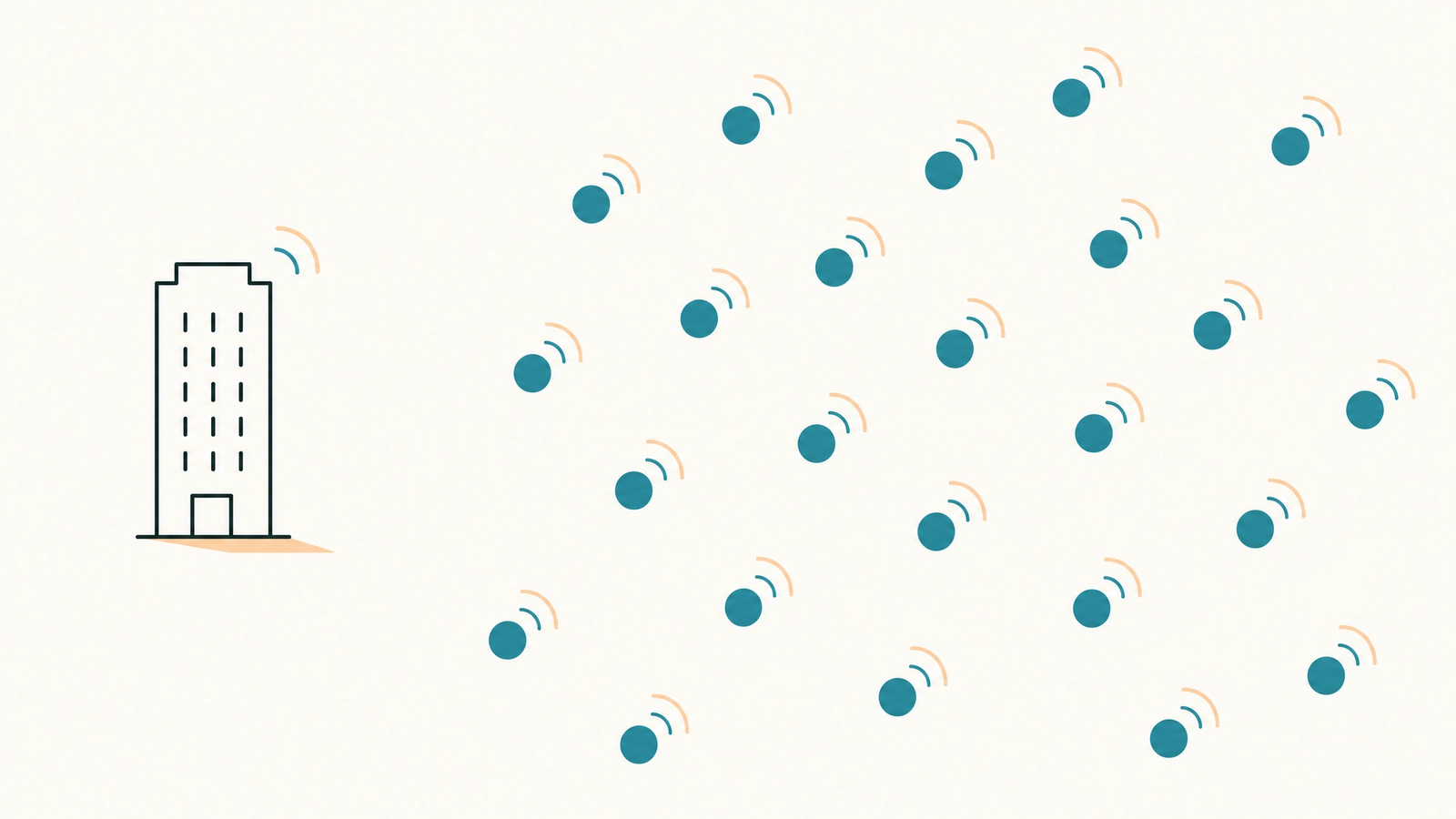
Employee-generated content, posts published by your team in their own voice, consistently outperforms the same message from your company page, and most organisations still pour everything into the one brand account. That is the gap this piece closes. A single company page is one voice with a shrinking ceiling: buyers trust people over logos, feeds reward individuals over brands, and AI answer engines cite many sources rather than one. Turning every employee into a publisher multiplies all three, reach, trust, and citations. It rarely happens for one reason: producing good content across dozens of busy people is slow and expensive. That cost is now removable, and the rest of this piece is how.
What is employee-generated content?
Employee-generated content is content created and published by individual employees in their own voice, on their own profiles or pages, rather than posts from the official company account. It ranges from a short take on a project to a full article, and its value is the original perspective only that person can offer. This is not the same as resharing the brand's updates. Resharing amplifies one voice; employee-generated content adds many. Each person also reaches a different network and speaks to their own slice of the audience, which is exactly why the sum covers more ground than any single page can.
Why does one company page cap your reach?
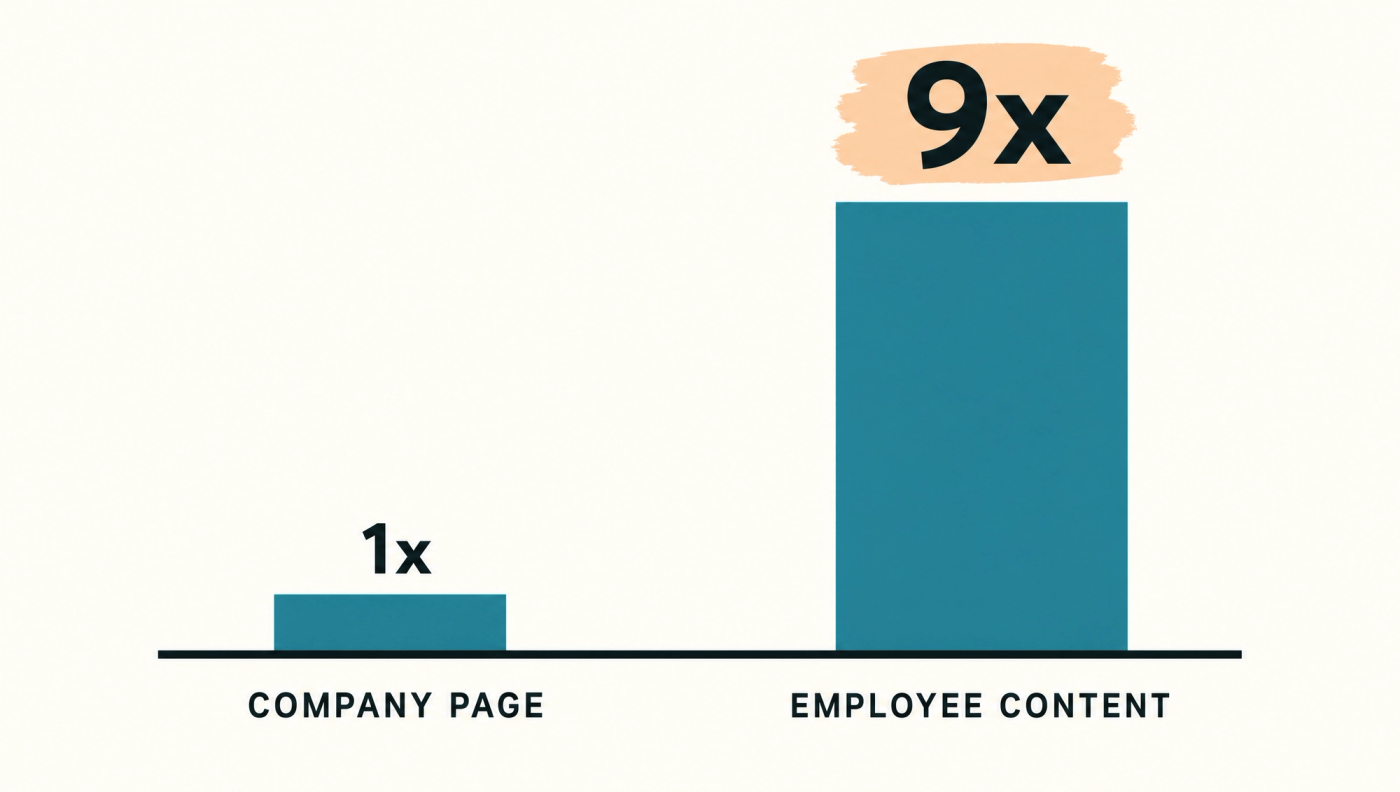
A single company page is one voice competing in feeds that increasingly favour people over brands. Content shared by employees earns up to nine times the engagement of the same material curated for a brand account (DSMN8, 2025). Trust runs the same way: 61% of people trust company content more when an employee shares it, and 92% of B2B buyers trust employee recommendations over traditional advertising (Sociabble, 2026). Buyers act on that trust, with 75% using social media to research vendors before they make contact (DSMN8, 2025). A brand page can still be a useful anchor, the place your best work lives, but leaning on it alone means competing for attention you have already ceded to your own people. The reach and the credibility a buyer feels before they call both sit with individuals.
How distributed content wins on AI search
Answer engines cite many entities and sources, not a single page, so more people publishing in your space widens the surface an AI can pull from. This is the heart of generative engine optimisation (GEO), the practice of getting your organisation cited in AI answers rather than only ranked in blue links. When ten employees each publish on their niche, they create ten times the material an assistant can quote, across ten times the questions. One company page answers a handful of queries in one voice. A distributed team answers the long tail, and when a buyer asks an AI which provider to trust, the organisation that shows up in more places, from more credible individuals, is the one that gets named.
What stops teams from publishing at scale
The barrier to distributed content is practical: producing good writing across many busy people is slow and expensive. Ask a team of thirty to post weekly and you get a fortnight of effort, then silence, because writing from a blank page is hard and most people are not writers. Voice is the other problem. Content that all sounds the same, or sounds like nobody, defeats the point, since the whole advantage was the individual perspective. This is why most employee advocacy programmes quietly become a feed of reshared brand posts. The ambition was distributed voices; the reality was one voice, forwarded.
How to turn every employee into a publisher
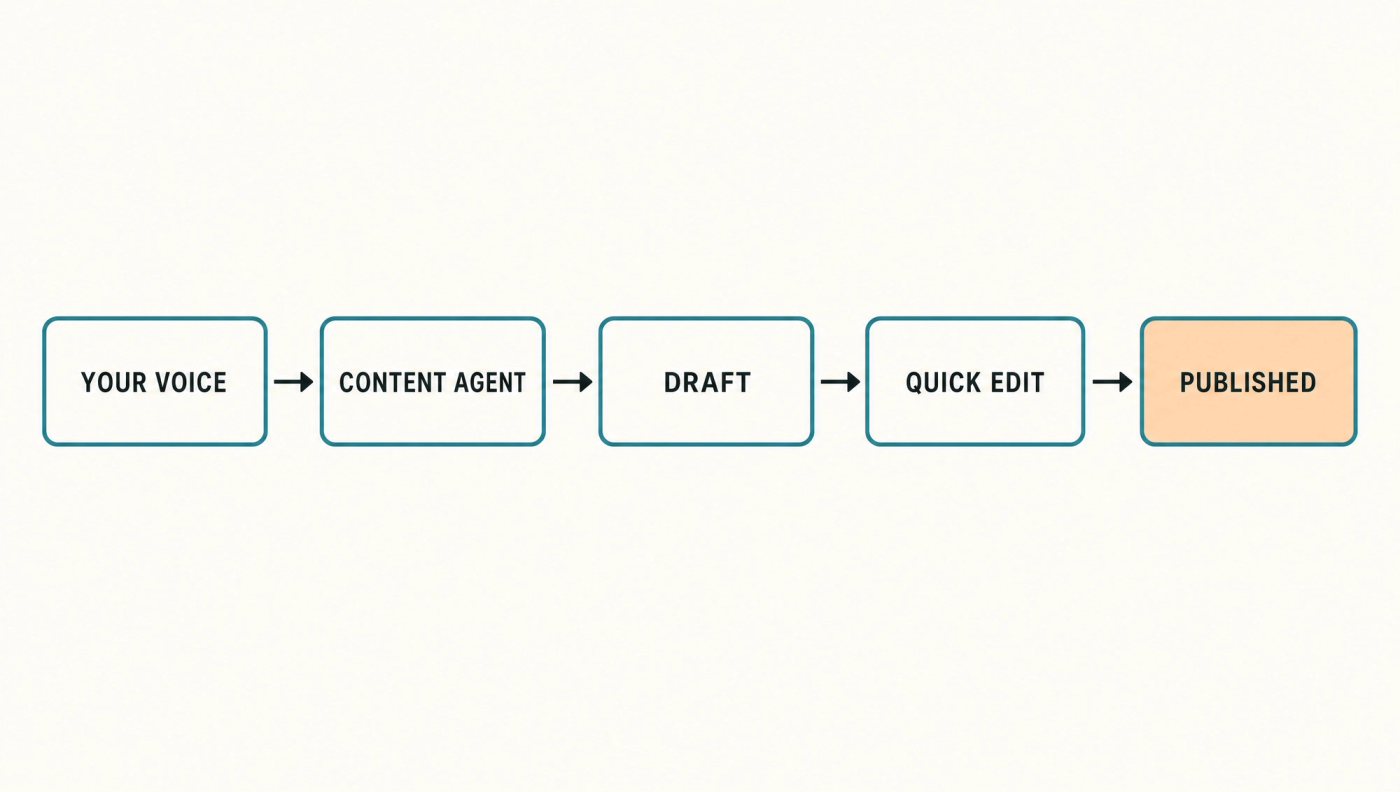
You remove the bottleneck by giving each person a content agent trained on their own voice, so drafts arrive sounding like them and the work becomes editing rather than writing. A content agent is a system that learns a person's phrasing and knowledge from their existing material, then drafts new posts in that voice, the same way a brand-trained agent writes for one company rather than the generic average. Point it at one person instead of one brand and you get content that is theirs by construction, not a template with their name on top. The person edits and approves in minutes rather than writing for an hour, which is the difference between a mandate nobody keeps and a habit that holds.
Author's tip: Start with five people, not fifty. A small group publishing every week beats a company-wide mandate nobody follows.
The distributed-content starter, in five steps:
- Pick five to ten people whose networks and expertise matter most.
- Capture each person's voice from what they have already written.
- Give each one a content agent that drafts in that voice.
- The person edits and approves, never starting from a blank page.
- Publish weekly, and anchor the strongest pieces back to one company hub.
Turn your whole team into publishers, not just your brand page
Apex learns each person's voice from their own work and drafts in it, so publishing becomes a weekly edit instead of a blank page.
See how Apex works
Where this leaves you
A company page is a fine anchor and a poor engine. The reach, the trust, and the AI citations all sit with your people, and the only thing that ever stopped you using them was the cost of producing content at that scale. That is the cost a content agent removes. Voholabs builds the agent that learns a voice and publishes in it, so a team of ten can sound like ten people rather than one page. Pick five people, give them a voice-trained agent, and publish this week. One page cannot outwork a team.
References
Frequently asked questions
- What is employee-generated content?Employee-generated content is content created and published by individual employees in their own voice, on their own profiles or pages, rather than posts from the official company account. It covers original posts, articles, and commentary, not just resharing the brand's updates.
- Is employee-generated content better than a company page?For reach and trust, usually yes. Employee posts earn far more engagement than the same content from a brand account, and buyers trust individuals over official channels. A company page still has a role as a reference hub, but it should be the anchor, not the whole strategy.
- How do you scale content across a whole team without it becoming a burden?The bottleneck is the manual writing, not the idea. Give each person a content agent trained on their own voice and knowledge, so drafts come out sounding like them. People edit and approve rather than write from scratch, which turns an impossible workload into a light weekly habit.
- Does employee content help with AI search and GEO?Yes. Answer engines cite many entities and sources, not one page. More people publishing in your space means more surface area, more citations, and more queries your organisation can answer, which is exactly what generative engine optimisation rewards.
Sources
- DSMN8, Social Selling Statistics You Need to Know (2025)
- Sociabble· Employee Advocacy Statistics