Content Engine: Tool, Agency, or Agent (And When Each Wins)
An SEO content engine comes in three forms: a tool you operate, an agency you brief, or an agent that does the whole job. Here is when each one wins.


You publish content every week, and you have already tried the software. A writing tool here, an optimisation tool there, perhaps a quote from an agency that came back at five figures a month. You can produce an article. The harder question is which way of producing it fits your situation, and that is what every SEO content engine decision really comes down to: which kind is right for you.
There are three kinds. A tool you operate, an agency you brief, and an agent that does the whole job for you. This piece sorts them by when each one wins, so you can stop comparing logos and choose a category instead. As of June 2026, the monthly price gap between them runs from £9 to well past £20,000, and picking the wrong category is the most expensive mistake of the three.
What is an SEO content engine?
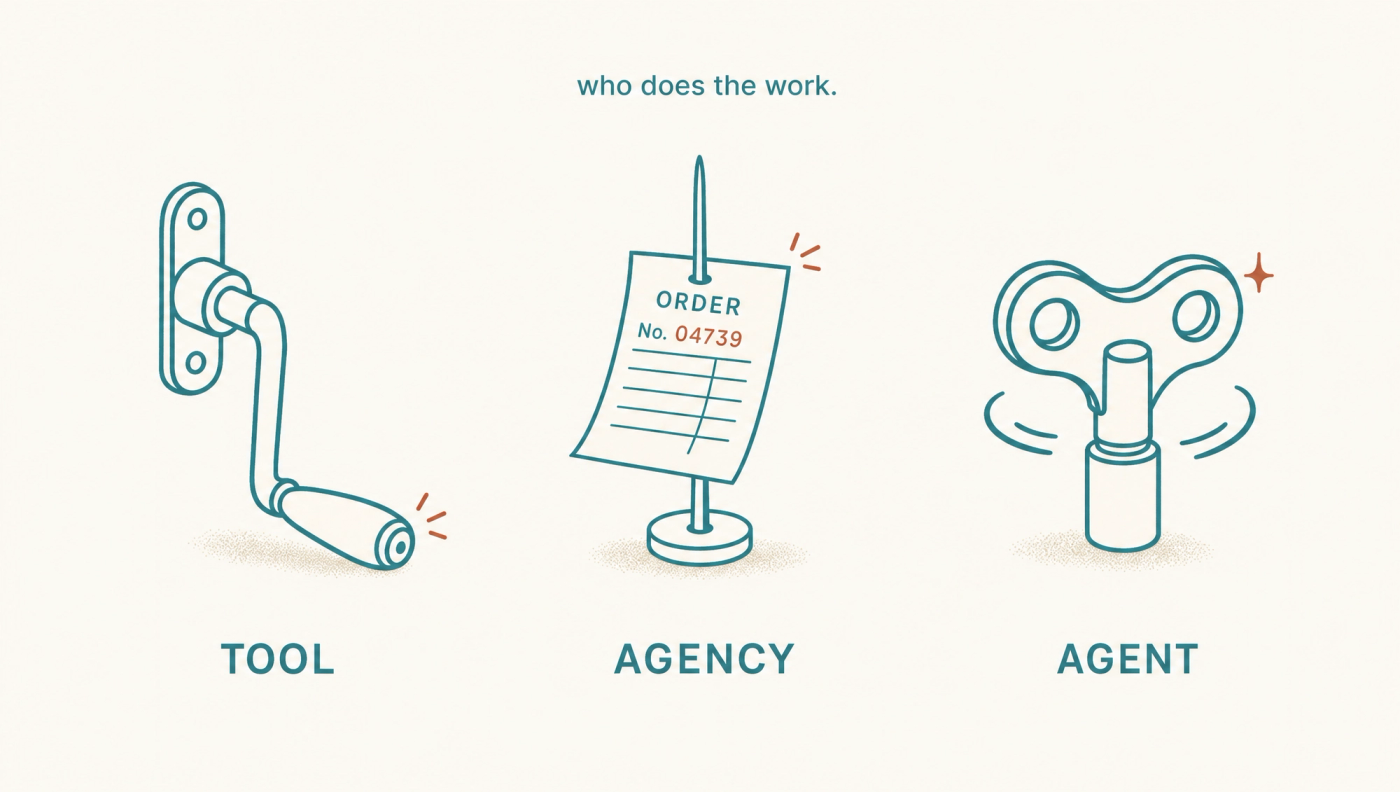
An SEO content engine is whatever you use to turn a keyword into a published article that ranks in Google and increasingly in AI search, and it takes one of three forms. The first is a content tool: software you log into and operate yourself. The second is a content agency: a team of humans you brief and pay a retainer. The third is a content agent: an autonomous service that researches, writes, and publishes for you. Each produces articles. What separates them is who does the work, what you own at the end, and what it costs you in money and in your own time.
When is a content tool the right call?
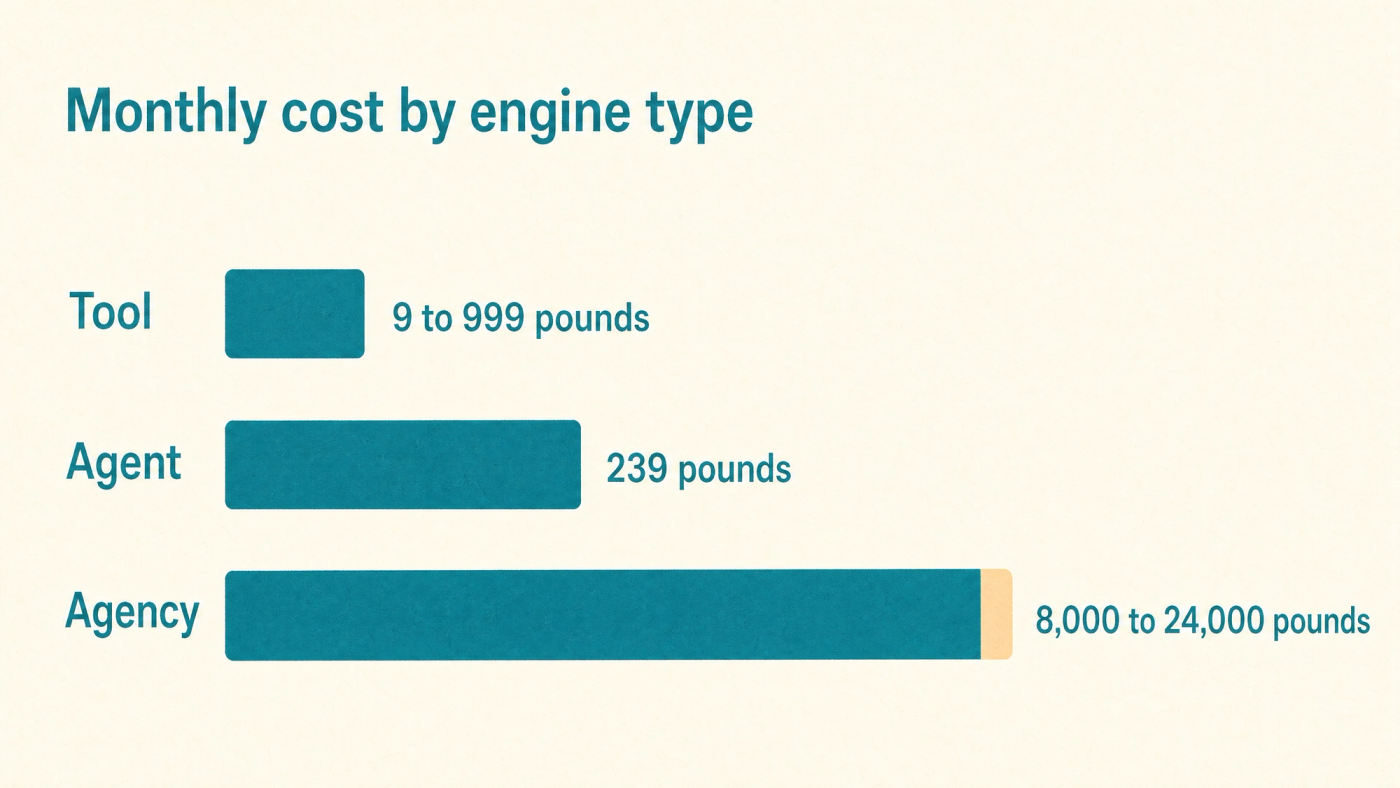
A content tool is the right call when you have someone with the hours and the appetite to drive it. You keep full control and you pay very little. A writing assistant like Jasper starts at $69 a month, an optimisation tool like Surfer runs from $49 to $999, and a drafting tool like Koala starts at $9 (Surfer, 2026; Koala, 2026). For that money you get a login and a blank cursor. The work, the judgement, and the publishing are still yours.
This is genuinely the cheapest sticker price of the three, and the only option that puts a visible quality score in front of you before you publish. The cost you do not see on the invoice is your own time. A tool only pays off if someone turns it into a repeatable habit, the same way a ready-made skill turns any AI tool into a repeatable specialist rather than a one-off prompt. If you are the operator and your week is already full, the maths is the same problem behind why most AI work never compounds.
When does a content agency earn the retainer?
A content agency earns its retainer when you need bespoke, human-crafted work rather than volume. Agencies like Brafton and Siege Media bring writers, designers, original research, and editorial direction that no software matches on a flagship piece. They quote on request: third-party reviews put full end-to-end retainers in the region of £8,000 to £24,000 a month, and Siege's own figures price a single outcome-driven post at $1,500 to $6,000 (Siege Media, 2026).
Verblio is the transparent exception, publishing rates of $0.06 a word for AI-assisted drafts and $0.16 a word for fully human writing (Verblio, 2026). The honest case for an agency is craft: if you want a landmark report, a designed asset, or a campaign a human team obsesses over, an agency out-produces both software and an agent. The honest case against is cost and cadence. Five figures a month buys depth, not daily volume, and you are still briefing people.
When does a content agent do the whole job?
A content agent is the right call when you want the published outcome rather than another login. It is an agentic service that researches, writes, and publishes in your brand voice, straight into your CMS, on a schedule, with no one re-briefing it each time. Voholabs runs one called Apex: a one-time setup of £799 and then £239 a month to run it for you. It learns your voice from your existing published content and operates inside your own environment.
The position between the other two is the point. An agent is cheaper than an agency retainer and far more hands-off than a tool, because it is brand-trained rather than templated and it does the publishing for you. One live UK deployment publishes around ten articles a day at roughly two minutes of human time each. It will not undercut a $9 tool on sticker price, and on a flagship asset a design studio still wins. Its strength is the steady, brand-aligned, compounding content asset that most operators actually need, the kind that captures the small share of buyers ready now.
How do you choose between them?
Choose by answering three questions about your own situation, not by ranking the vendors. First, do you have an operator with spare hours who wants to keep control? Buy a tool. Second, do you need bespoke, human-crafted flagship assets and have the budget to match? Hire an agency. Third, do you want consistent, brand-aligned content published for you at a fixed monthly cost? Use an agent. The right SEO content engine is the one that matches your situation, not the one with the loudest reviews.
The noise in this market is that all three are sold as direct competitors, as if one must be best. Each is simply an answer to a different situation, and the same brand often uses two at once: an agent for steady volume, an agency for the occasional landmark piece. Knowing who your buyer actually is and where you publish matters more than the brand on the invoice.
You want the outcome, not another login.
Apex is a content agent built for one brand: your voice, your CMS, your niche, published while you sleep.
See how Apex works
Where this leaves you
Three engines match three situations. Buy a tool if you have the time and want control, an agency if you need bespoke craft and have the budget, an agent if you want brand-aligned volume handed to you for a fixed cost. The costly mistake is choosing the wrong category of engine for your situation, not the wrong vendor within a category. Answer the three questions, match the engine to your reality, and the shortlist writes itself.
Pick the engine your situation needs.
References
Sources
- Surfer SEO· Pricing
- Koala· Pricing
- Jasper· Pricing
- Verblio· Pricing
- Brafton· Content Marketing Agency
- Siege Media· Content Marketing Agency