SEO vs AEO vs GEO: What Each Means
SEO, AEO, and GEO are not three competing strategies. They are one job with three labels, and a single answer-first move wins all three at once.

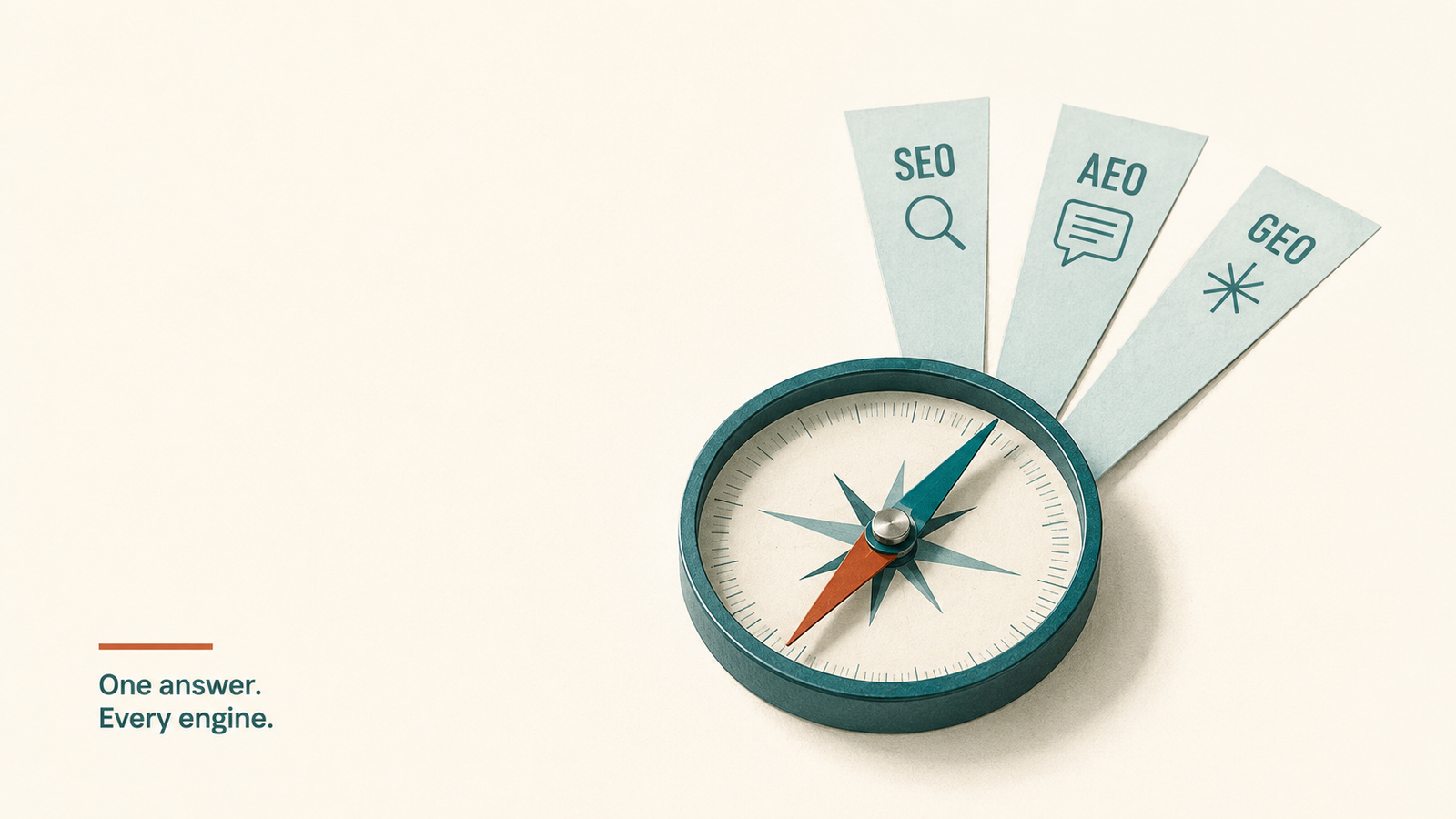
Three acronyms are now fighting for space in your marketing budget: SEO, AEO, and GEO. Two of them did not exist eighteen months ago. Each one arrives with its own consultants, its own checklist, and its own claim that the last one is dead. Meanwhile 68% of Google searches in early 2026 ended without a single click to an outside website, so the ground genuinely has shifted. Here is the noise filtered to what matters. SEO vs AEO vs GEO is not three strategies competing for your money, it is one job wearing three labels, and a single move covers all three. You are probably AI-enabled right now: using the tools, with no system that compounds. This is how you reach the stage past that.
What do SEO, AEO, and GEO actually mean?
SEO, AEO, and GEO are three layers of the same task: being found when someone looks for what you do. The labels describe where the finding happens, not three rival disciplines. Here is each one in a single line.
- SEO (search engine optimisation) is the practice of getting your pages to rank in the list of blue links on an engine like Google. The reader clicks through to your site.
- AEO (answer engine optimisation) is the practice of getting your content quoted as the direct answer, in featured snippets and AI Overviews, so the engine resolves the question on the results page without a click.
- GEO (generative engine optimisation) is the practice of getting your brand named and cited inside the answers that generative assistants like ChatGPT, Gemini, Copilot, and Claude write from scratch.
Read those three definitions again and SEO vs AEO vs GEO stops looking like a contest. All three reward the same thing: content a machine can trust and lift. The only real difference is the surface the answer appears on.
Why the three are really one job now
The line between ranking, answering, and being cited has collapsed into one outcome: be the clearest quotable answer. When an AI Overview appears, Ahrefs found the top-ranking page loses 34.5% of its clicks, because the answer is already sitting on the results page. Classic SEO on its own now optimises for the shrinking minority of searches that still send a click.
The deeper point is mechanical. The same authority signals feed all three engines: clear structure, sourced claims, a real author, and content that genuinely answers the question. Get those right and you rank, you get quoted, and you get cited from the same page. Treat them as three separate projects and none of them compounds.
Where each one sends value, and why AI citations convert
AI-cited traffic is smaller in volume but it converts harder than classic search. Across 94 ecommerce sites over twelve months, Visibility Labs found traffic from ChatGPT converted at 1.81% against 1.39% for non-branded organic search, roughly 31% higher. Fewer visitors, warmer intent: someone the assistant has already pointed at you arrives half-sold.
This is why the work that wins one market first, then scales, beats spray-and-pray reach. An AI content agent built around your buyers' real questions earns those citations on purpose rather than by accident.
What is the one move that covers all three?
Write content that states a clear, standalone answer a machine can lift without the rest of the page. Open every section with one sentence that answers the question on its own, then back it with a number and a named source. That single habit is what ranks in SEO, what gets quoted in AEO, and what gets cited in GEO. One move, three wins.
The research backs it. The Princeton GEO study found that structuring content with citations and statistics raised a source's visibility inside generative answers by up to 40%. Writing to one buyer, with specific and sourced claims, is the same craft that has always earned trust. The engines just made it the price of entry.
You do not need a new tool for this. Keep an llms.txt file so assistants can read your site cleanly, publish on your own blog rather than rented platforms, and once a piece works, turn the format into a reusable skill so every future article ships answer-first by default.
Drowning in SEO, AEO, and GEO checklists? We filter the noise and build one answer-first content engine around your buyers, so a single workflow earns rankings, snippets, and citations. See how voholabs does it.
Where this leaves you
Stop running three playbooks against three acronyms. SEO vs AEO vs GEO collapses into one job: be the clearest, best-sourced answer to the question your buyer is actually asking. Do that and you move from AI-enabled, using the tools in scattered bursts, toward AI-first, where one content system compounds across every engine at once. We build that system with teams who are tired of guessing. Write the answer, not the article.
References
Frequently asked questions
- Do I have to choose between SEO, AEO, and GEO?No. They are three layers of one job: being the clearest answer a machine can quote. SEO ranks your page, AEO gets you quoted, GEO gets your brand cited by assistants. One answer-first move serves all three.
- If I already rank on Google, do I still need AEO and GEO?Yes. 68 percent of Google searches in early 2026 ended without a click, so ranking alone reaches a shrinking minority. Being quoted in the answer is increasingly where the attention and conversions are.
- What single change improves all three at once?Open every section with a standalone, sourced answer a machine can lift without surrounding context. That one habit helps you rank, get quoted, and get cited together.
Sources
- In 2026, Less than One Third of Google Searches Still Send a Click· SparkToro
- How AI Overviews Affect Clicks· Ahrefs
- ChatGPT ecommerce traffic converts 31% higher than non-branded organic search· Search Engine Land
- GEO: Generative Engine Optimization· arXiv (Aggarwal et al.)