Query Fan-Out Mapping: 161% More AI Citations in 30 Minutes
Query fan-out breaks one buyer question into many searches. Pages that answer the sub-queries are 161% more likely to be cited. Map yours in 30 minutes.

By Mehrdad Sadeghi, August 2026, 5 min read
A buyer types one line into an AI assistant: which content partner should I use for B2B SEO. Behind that line the engine fans out into a batch of its own searches, one for pricing, one for alternatives, one for what other buyers said, and the page you wrote for the question they typed never surfaces in the ones you never saw. That gap is query fan-out, and the fix is to map those sub-questions and publish the answers: pages that rank for fan-out queries are 161% more likely to be cited in an AI answer than pages ranking for the head term alone, according to a December 2025 study of 173,902 URLs. If you publish regularly and still cannot work out why the assistants keep naming someone else, the miss is coverage of questions you never saw. This piece gives you a 30-minute map that finds your buyer's sub-questions and tells you which three to answer next.
What is query fan-out in AI search?
Query fan-out is the retrieval step where an AI engine breaks one question into sub-topics, runs many searches at once, and writes a single answer from the passages it collects. Google described the mechanism in its own words on 20 May 2025: "AI Mode uses our query fan-out technique, breaking down your question into subtopics and issuing a multitude of queries simultaneously on your behalf." Deep Search runs the same technique harder, issuing hundreds of sub-queries for one research question.
The practical consequence is that your buyer asks once and the engine asks many times. Those sub-questions never appear in your analytics, they are not in your keyword tool, and the assistant does not report them back to the person who typed. You find out you were absent from them only by never being named in the answer, the same silence described in why an empty blog stays invisible.
Why does one strong article lose the citation?
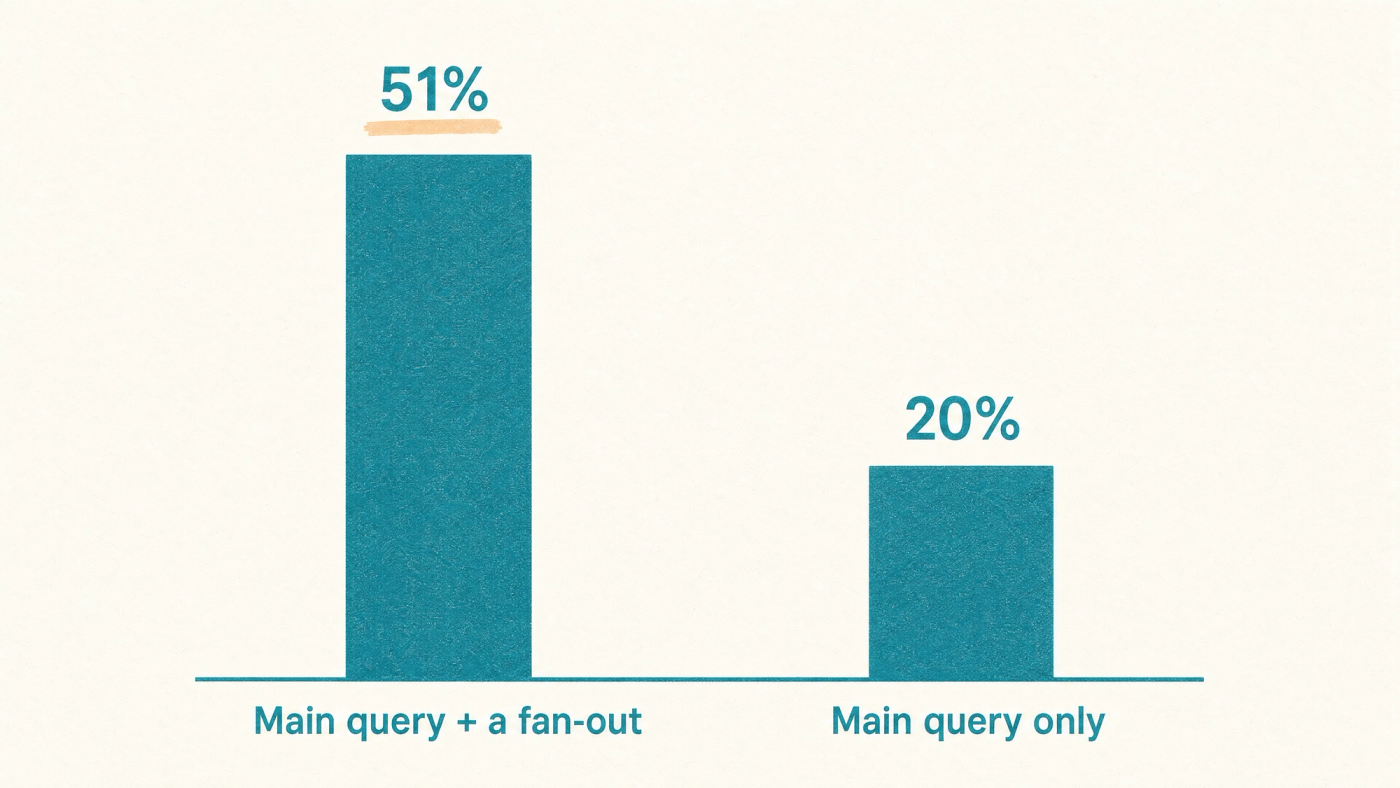
Ranking for the head term is now a minority position in AI citations. Surfer analysed 173,902 URLs across 10,000 keywords in December 2025, extracted 33,000 fan-out queries with Gemini, and compared which pages the engines actually quoted. Pages that ranked for the main query and at least one fan-out took 51% of AI Overview citations. Pages that ranked only for the main query took just under 20%. The correlation between fan-out coverage and citation likelihood came out at 0.77, which in this kind of study is about as clean a signal as you get.
One more figure from the same study is worth holding onto: roughly 68% of cited pages did not rank in the top ten for either the main query or any fan-out query. A page can be pulled into an answer from well down the results if it holds the passage the engine needed, which is why generative engine optimisation rewards breadth of clean answers over one heavily optimised page, and why the three labels SEO, AEO and GEO resolve to the same job.
How do you map the fan-out for one buyer question?
A fan-out map is a one-page list of the sub-questions an engine is likely to ask on your buyer's behalf, plus which of your pages answers each one. It takes about half an hour for one question, and you only need one to start.
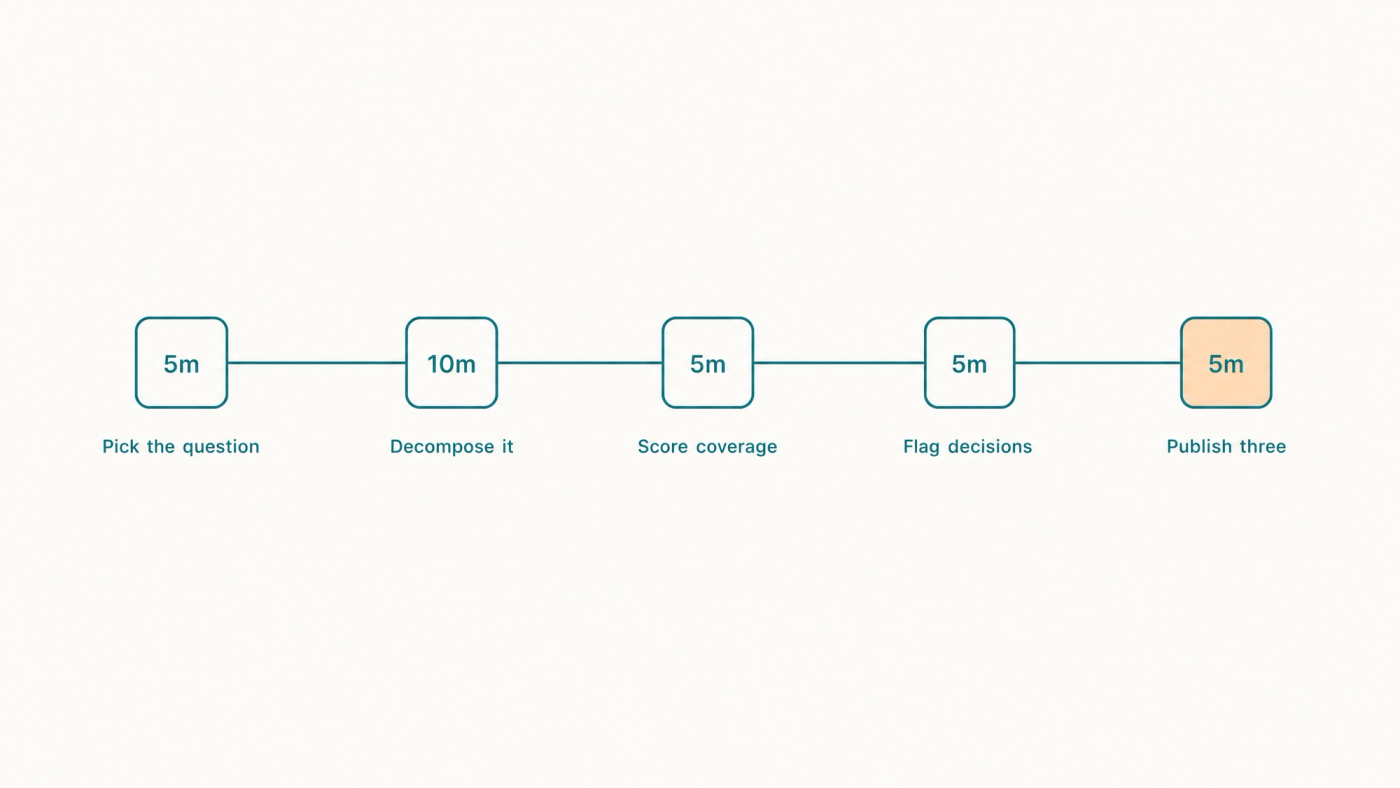
- Pick the question (5 minutes). Use a question a real buyer asked you this month, in their words, not a keyword. If the wording is fuzzy, tighten it against how you define your buyer.
- Generate the fan-out (10 minutes). Give your AI assistant the retrieval role directly: "Act as the retrieval layer of an AI search engine. Decompose this buyer question into the sub-queries you would run in parallel to answer it. Group them by intent: definition, comparison, pricing, process, proof, risk." Paste your sector and your buyer's situation underneath so the output is yours rather than generic.
- Score your coverage (5 minutes). For each row, ask whether one of your live pages answers it cleanly in its first 100 words. Yes, partly, or no.
- Mark the decision rows (5 minutes). Flag the sub-queries a buyer asks when they are close to choosing: pricing, alternatives, proof, what goes wrong.
- Pick three (5 minutes). Three gaps, published as clean answers, beats forty rows of ambition.
Each row carries five fields: the sub-query, its intent, the page of yours that covers it, whether that page answers it in the first 100 words, and the call (hold, fix, or publish). Four rows from a real map read like this:
- What does an AI content agent cost. Pricing intent, covered by the cost-per-article page, answered up front, hold.
- AI content agent versus an agency. Comparison intent, covered by the content engine page, buried below the fold, fix.
- Does AI-written content actually get cited. Proof intent, no page at all, publish.
- What happens if the AI writes off-brand. Risk intent, covered by the brand-voice page, answered halfway down, fix.
Which sub-queries are worth answering?
A fan-out map for one question can run to forty rows, and fewer than ten of them decide whether a buyer picks you. Answering all forty is how a team burns a quarter and still gets outranked by a competitor who wrote four pages. Noise filtering, deciding which of the available signals actually matter in your context and dropping the rest, is the whole job at this stage.
Three filters do most of the work. A row survives if a buyer would ask it within a week of deciding, if you can answer it with something only you hold (your pricing, your method, your results, your refusals), and if the answer is repeatable enough that a buyer could say it to a colleague without opening your site again. Rows that fail all three are someone else's article, and monitoring tools will keep reporting your absence from them without ever closing the gap.
Map one buyer question, get the three pages that close it. Voholabs filters your fan-out down to the sub-questions that move a decision, then writes the answers in your voice, on your site. Start at voholabs.com.
What does this change about how you publish?
Fan-out mapping is the move that takes you from AI-enabled publishing to AI-first publishing. AI-enabled means you use an assistant to draft faster, one article at a time, with nothing carrying over between them. AI-first means you build the input the assistant works from, so every piece lands against a map of real buyer questions rather than a keyword and a hope. The staircase runs one further step to AI-native, where the map updates itself and the publishing happens without you re-briefing anything.
The one move for this week: attach the fan-out map to your next content brief, and require every article to answer four to six mapped sub-queries with the answer stated in its first 100 words. That constraint turns a good article into a citable one, and it holds only when the writing sounds like you rather than the model, the same reason generic AI output gets ignored. Who runs the mapping is then a straight choice between a tool, an agency, or an agent. Voholabs runs it as Apex, an agent trained on your brand that maps the fan-out, writes the missing answers, and publishes them to your site on a schedule.
Where this leaves you
AI engines answer the cluster of questions behind the one your buyer typed, and citations follow coverage of those sub-questions rather than rank on the head term. Take one question a buyer asked you this month, build the map, and publish the three answers you are missing. If you would rather the mapping and the writing ran without your Thursday afternoons, priced against every other route per published article, that is the job Voholabs does, in your voice, on your own site.
Map it this week.
References
Frequently asked questions
- Is query fan-out only a Google thing?No. Google names the technique in AI Mode, and the same decomposition happens whenever an assistant researches a question before it answers. Any engine that retrieves before it writes runs a version of it, which is why the map is built around buyer intent rather than one platform.
- How many sub-queries does an engine run for one question?It varies by question and by run. Google says AI Mode issues a multitude of queries at once, and its Deep Search mode can run hundreds for a single research question. The count moves enough between runs that mapping for breadth of intent beats chasing an exact number.
- Do I need new pages, or can I expand the ones I have?Both work, and the cheaper one wins first. If an existing page covers the sub-query but buries the answer, move a clean answer into its first 100 words. If nothing covers it, publish a new page built around that single question.
- How do I know the mapping is working?Run the same set of buyer prompts through the assistants on a fixed schedule and record whether your brand appears and which pages get cited. Monitoring reports the movement; the published answers are what cause it.
Sources
- AI Mode in Search update· Google
- AI Overview fan-out rankings boost citation odds by 161%· Search Engine Land