AI Visibility Monitoring in 2026: What It Shows (And What It Can't Fix)
AI visibility monitoring tells you what ChatGPT and Perplexity say about you. It cannot write the page that changes the answer. Here is the order to buy in.


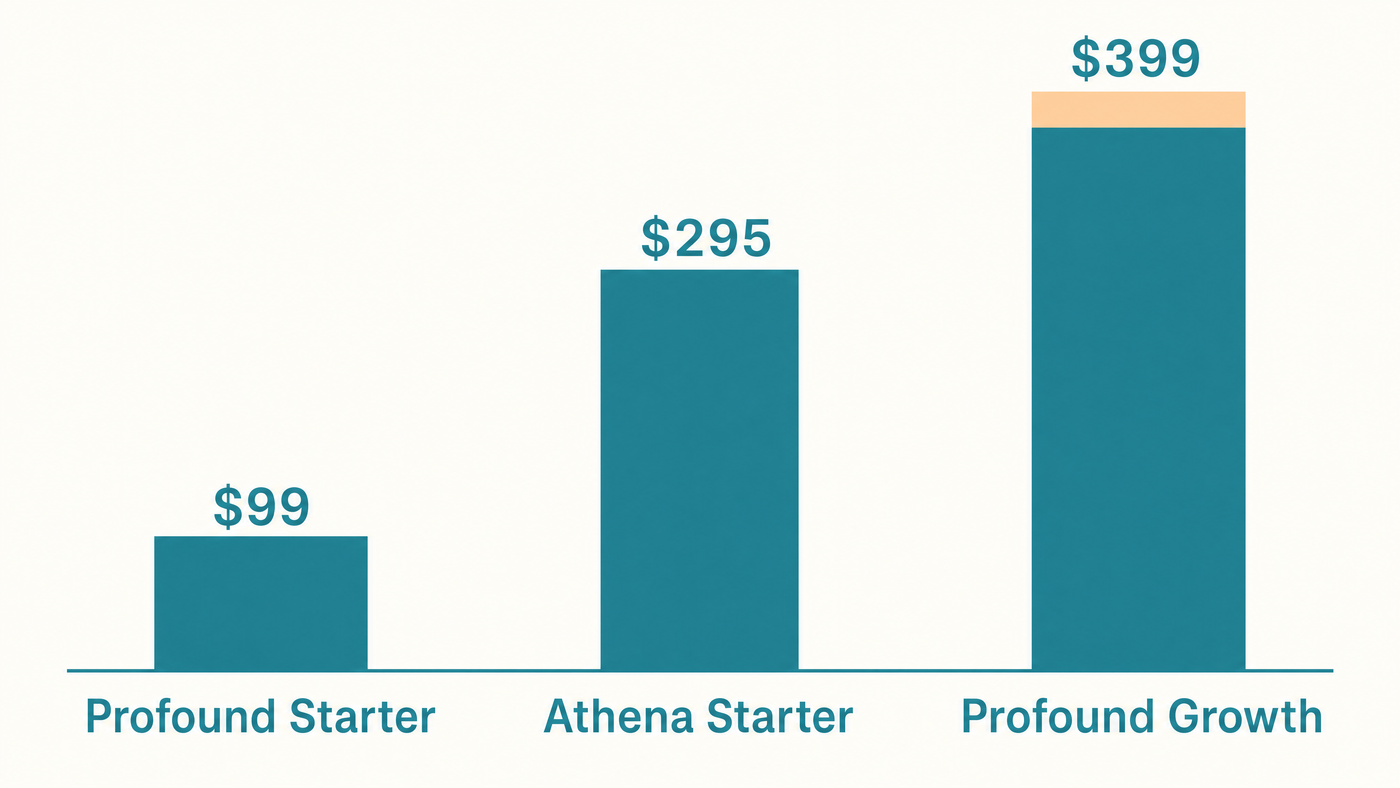
A GEO monitor starts at $99 a month with Profound and $295 a month on Athena's Starter plan, and neither figure buys a single sentence an AI engine can quote. That is the gap this piece closes. AI visibility monitoring measures how ChatGPT, Perplexity and Google AI Overviews describe your brand; creating content is what changes what they say. GEO, generative engine optimisation, is the practice of earning mentions and citations inside AI-generated answers rather than blue links. The two jobs are complements, and the order you buy them in decides whether the spend pays. If you already publish heavily, buy the monitor first and find out where you stand. If your citable surface area is thin, measurement will only document the silence in higher resolution.
What does AI visibility monitoring actually measure?
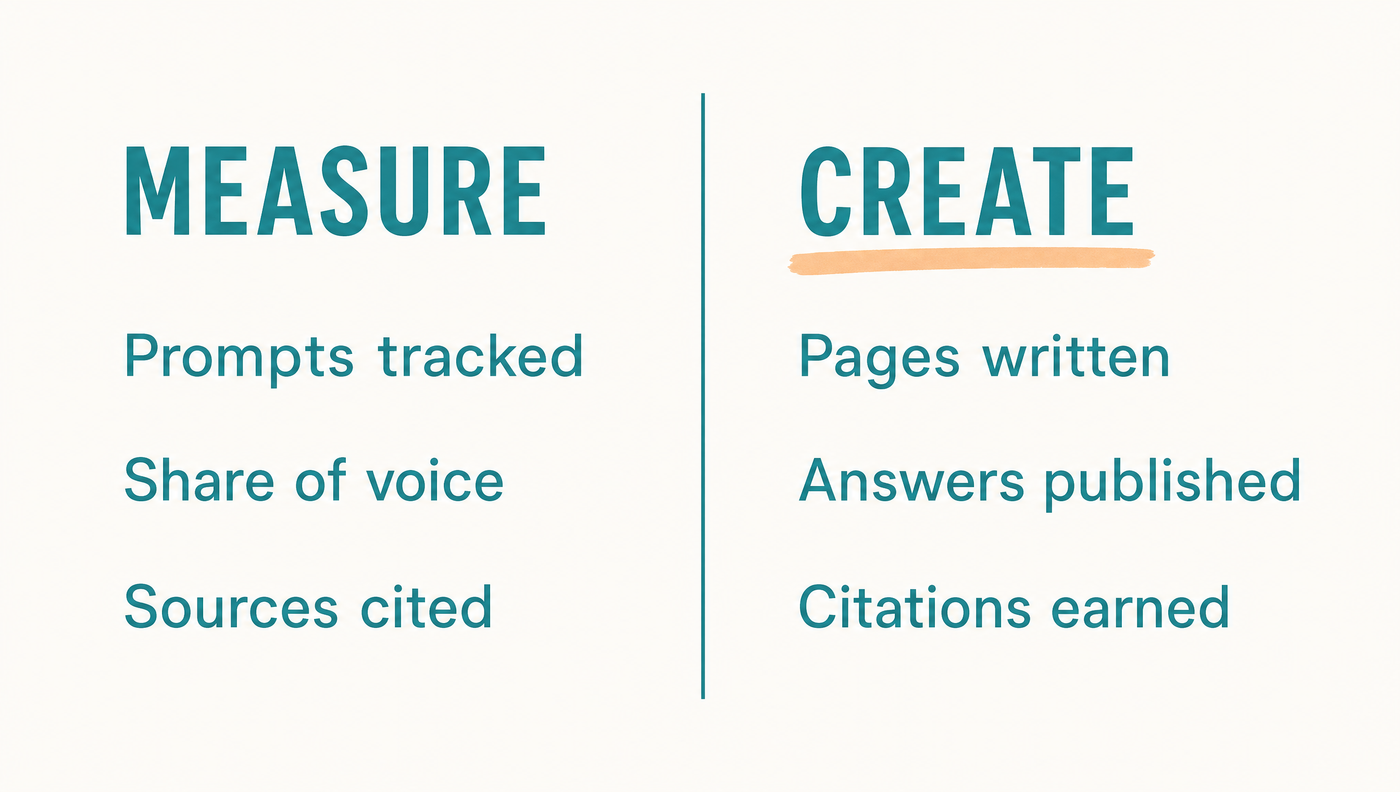
AI visibility monitoring is software that runs a fixed set of buyer prompts through AI answer engines on a schedule and records whether your brand appears, how it is described, and which sources the engine cited. That is the whole job. You get share of voice against named competitors, sentiment on your own brand, and the specific pages the engine reached for when it built its answer.
Checked on 20 July 2026, the two best-known platforms price it like this.
- Profound Starter, $99 a month. ChatGPT only, 50 tracked prompts, one seat, 100 agent credits.
- Profound Growth, $399 a month. Three answer engines, 100 tracked prompts, three seats, 400 credits.
- Athena Essential, free. 300 credits, prompt and response analysis, competitor and source insights.
- Athena Starter, $295 a month. Nine AI models including ChatGPT, Perplexity, Gemini and Google AI Overviews, 3,600 credits, API access and CSV export.
Both price on credits, so the cost scales with how many prompts you watch and how often you watch them, and both sell enterprise tiers on custom pricing. Neither writes the article. The line between search, answer engine and generative optimisation is worth holding onto here, because monitoring sits on the reporting side of all three.
Why does a monitor not earn the citation?
A monitor reports on the answer; it cannot supply the material the answer is assembled from. Answer engines build responses out of pages that already exist and can be lifted cleanly: a plain definition, a specific number, a direct answer sitting under a heading that matches the question. If nothing on your domain answers the prompt in that shape, the dashboard will show a flat zero every week and be entirely correct.
Semrush found that over 88% of searches triggering a Google AI Overview are informational, which tells you what the engines are reaching for: explanatory material, not a pricing page. The same research puts the average AI search visitor at 4.4 times the value of the average traditional organic visitor, which is why the citation is worth chasing at all. This is also the practical reason AI answers about your brand go wrong. Engines quote whatever is available, so if the available material is a competitor's teardown of your category, that is what gets quoted.
The correction is to publish the answer yourself, in a form that lifts cleanly, on a surface the crawlers can read. How AI picks one brand over another covers the selection mechanics, and llms.txt covers the file that tells AI crawlers which of your pages matter.
Please note: the content recommendations a monitor hands you are still recommendations. A person or an agent has to research, write, edit and publish every page on that list. That production cost is the decision you are actually making.
When is a GEO monitor the right first buy?
If you already publish eight or more substantial pieces a month, buy the monitor before you buy more production. A brand with a real archive has a supply of citable material and no idea which parts of it are landing, and that is precisely the question a monitor answers. Answering it cheaply changes what you commission next quarter.
Athena's free Essential tier makes that first look cost nothing, which is a better entry point than anything on our side of the fence. Profound's prompt-level data across ten or more answer engines is deeper than the reporting any content agent produces, so if competitive intelligence in AI search is the actual job, Profound is the better buy.
The reverse case is the common one. A site with twenty pages, most of them product and about-us, does not have a measurement problem. Every prompt comes back empty because there is nothing to cite, and paying $399 a month to watch that stay empty is an expensive way to learn what one afternoon of auditing would tell you. Owning one market before you scale is usually a cheaper route to a first citation than buying visibility into a gap you already know about.
How do content creation and AI visibility monitoring work together?
The loop that works runs create, measure, correct, repeat, with the monitor naming the gaps and an agent filling them. Apex is Voholabs' content agent: a custom AI agent that studies your niche, competitors and existing voice, then researches, writes and publishes articles straight into your CMS. It is an agentic service rather than a platform you log into and operate, which is the difference between a tool, an agency and an agent.
Setup is £799, covering integration, voice calibration and the first month, then £239 a month covers hosting, model costs and daily running. Against an agency retainer, that is a fraction of the monthly cost.
- Pull the 20 to 40 prompts your buyers actually type into an AI assistant. Those are the targets that matter.
- Run them through a monitor once and record where you are absent, thinly mentioned, or described wrongly.
- Hand the empty prompts to the agent as a content queue. One page per prompt, answering it directly, in your voice.
- Re-run the same prompt set 60 days later. The delta is your GEO return, and it tells you which topics to double down on.

That loop is the two things Voholabs does, in practice. Noise Filtering means cutting the AI landscape down to what is actually relevant to you: forty prompts, not a four-thousand-line keyword export. Customization means making the work specific to your role, workflow and context, so the agent writes from your positioning, in your voice, into your CMS. Content that reads like everyone else's does not get cited, and a templated platform cannot fix that.
Teams at this stage are usually AI-enabled: an assistant open in a tab, a few saved prompts, nothing compounding week to week. AI-first is when the winning prompts get codified into an agent that runs on a schedule. AI-native is when the pipeline only exists because AI does, with the monitor wired in as its feedback signal. The four steps above are the move from AI-enabled to AI-first.
Earn the citation, do not just watch yourself miss it. Apex researches, writes and publishes in your voice for £799 setup and £239 a month, and hands over the code, prompts and configs if you ever want to run it in-house. See how Apex works
Where this leaves you
Monitoring and creating answer different questions. A GEO monitor tells you where you stand in AI answers today, with real precision, and for nothing at all on Athena's free tier. It will not write the page that changes the answer. If you publish heavily, start with the monitor and let the gaps commission your next quarter. If you do not, start with the material. Voholabs builds that second half: one content agent, tuned to one brand, publishing into one CMS, on the schedule you set. Buy the monitor once there is something to measure.
References
Frequently asked questions
- Do I need both a GEO monitor and a content agent?Eventually yes, because they do different jobs. A monitor measures how AI engines describe you; a content agent produces the pages those engines can cite. If your archive is thin, start with production. If you already publish weekly, start with measurement and let it direct what you commission.
- Is Profound or AthenaHQ better for tracking AI visibility?Profound goes deeper on prompt-level data across more answer engines, which suits competitive research. Athena has a free Essential tier and a $295 a month Starter plan covering nine models, so it is the cheaper way to take a first look. Both were checked on 20 July 2026 and both price on credits, so cost scales with how many prompts you watch.
- Are a monitor's content recommendations enough to fix my AI visibility?Only if someone acts on them. Recommendations are a queue, not an output. Every item still needs research, drafting, editing and publishing, and that production cost is the real decision you are making when you compare a tracking subscription with a content agent.
- How long before new content shows up in AI answers?Plan on 60 days before you re-measure. Answer engines need the page indexed, then need to select it against everything else covering that prompt. Re-running the same prompt set after two months gives you a clean before and after rather than day-to-day noise.
Sources
- Pricing· Profound
- Plans and Pricing· Athena
- 26 AI SEO Statistics for 2026· Semrush
- We Studied the Impact of AI Search on SEO Traffic· Semrush