Getting Found by AI in 2026: Why an Empty Blog Stays Invisible (And the Fix)
Getting found by AI with an empty blog is a filtering problem, not a volume one. Publish the few clearest answers to your buyers' first questions, then ramp.

Two companies sell the same thing. One gets named when a buyer asks an AI assistant "who should I use for this?". The other has a blog with three posts and a contact form, and the model has never heard of it. The difference is not budget or age. It is that one of them gave the model something to surface and the other left the cupboard bare. Getting found by AI when you start from nothing is a real problem with a known sequence, and most early-stage founders skip the one step that makes it work. This piece walks the cold-start sequence and the move that gets an empty blog its first AI citations.
Getting found by AI is the new version of getting found at all. When a buyer asks ChatGPT, Copilot, Gemini, or Claude for a recommendation, the model answers from what it can retrieve and trust. An empty blog gives it nothing to retrieve. The fix is not to flood the internet with posts. It is to publish the few clearest answers to your buyers' first questions, then ramp deliberately.
Why does an empty blog stay invisible to AI?
AI assistants answer by retrieving real documents and quoting them, not by inventing recommendations from thin air. This is retrieval-augmented generation: the model pulls source pages that match the question, then synthesises an answer from them. If your site has nothing that matches the question your buyer typed, you are not in the retrieval set, and you cannot be in the answer. That is the cold start. You are not penalised, you are simply absent.
Absence is the default state for any new business, and it is worth naming honestly. You are in the AI-enabled stage: you use AI tools daily, maybe you drafted your homepage with one, but nothing you have published is working for you while you sleep. The next stage is AI-first, where a running content engine answers your buyers' questions on a schedule and the model starts surfacing you. The move that gets you there is not volume. It is picking the right first questions.
What does getting found by AI actually require?
Getting found by AI requires three things the model can act on: pages that answer a real question, recency, and enough clarity that the answer is quotable. Recency matters more than founders expect. AI search platforms cite content that is 25.7% fresher than the content cited in traditional organic results, and 76.4% of ChatGPT's most-cited pages had been updated in the previous 30 days (Ahrefs, 2026). A brand-new site is, by definition, all fresh. That is the one structural advantage of starting from zero.
The second requirement favours you too. Across AI Overviews, 93.8% of linked sources come from outside the first page of traditional search results (Nightwatch, 2026). The model is not just rewarding the incumbents who already rank. It is reaching for the page that answers the specific question best, wherever it sits. An empty blog is not behind by years. It is behind by a handful of well-aimed pages.
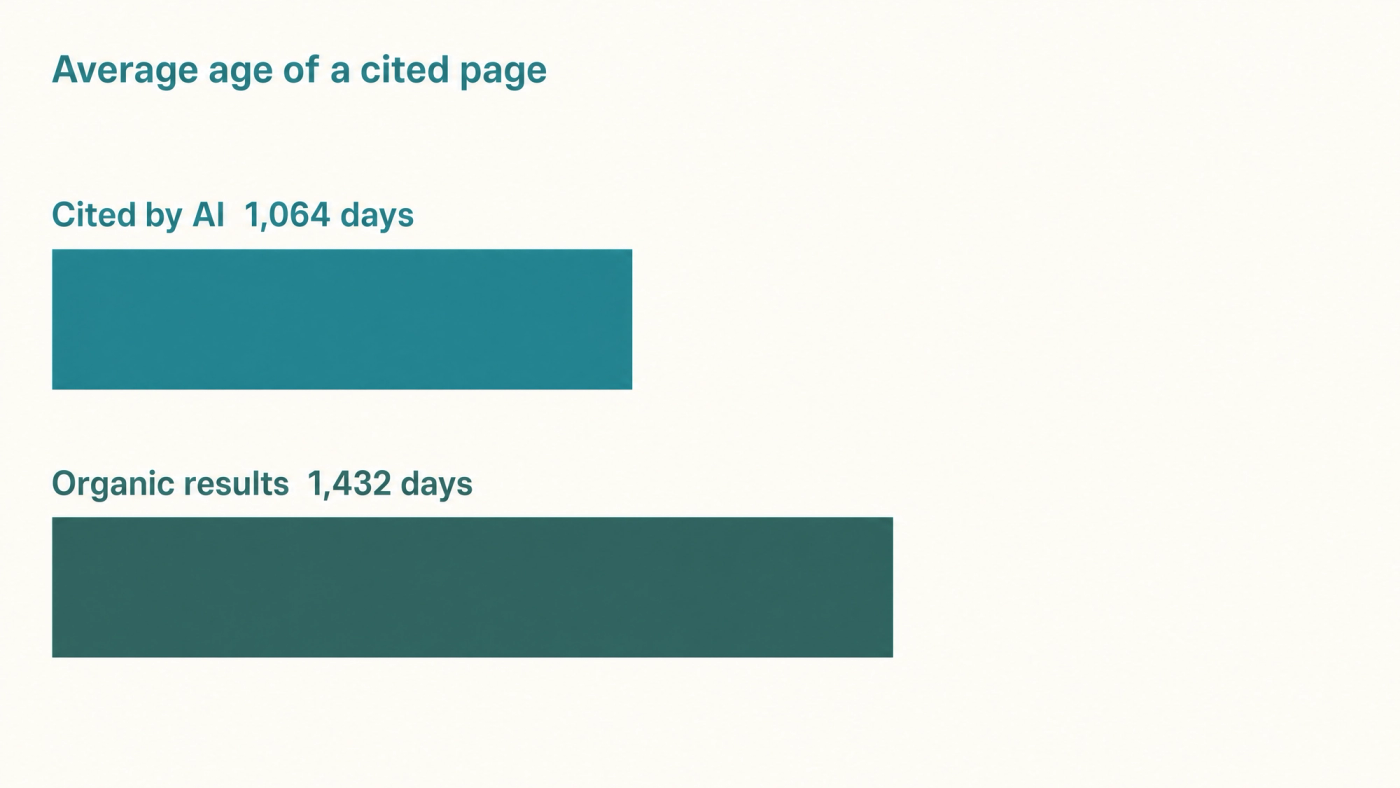
In practice, this means: you do not need to outrank a competitor's whole domain. You need to own the answer to one specific question they have not bothered to write down clearly.
How do you find the few questions worth answering first?
The cold-start sequence starts with Noise Filtering, the discipline of cutting through the overwhelming spread of possible topics to find the few that actually matter. There are thousands of things you could write about. Almost none of them are what your buyer types into an AI assistant before they buy. The job is to find the short list that is both high-intent and uncrowded, and ignore the rest.
This is where most founders go wrong. They either freeze, because the topic space feels infinite, or they flood, publishing twenty thin posts chasing broad head terms they will never rank for. Both fail. The filter that works is the long-tail question. Searches that open with a question word (who, what, when, why) return an AI summary 60% of the time, and 36% of searches written as a full sentence do the same (DemandSage, 2026). Specific questions are less crowded and more likely to get you quoted.
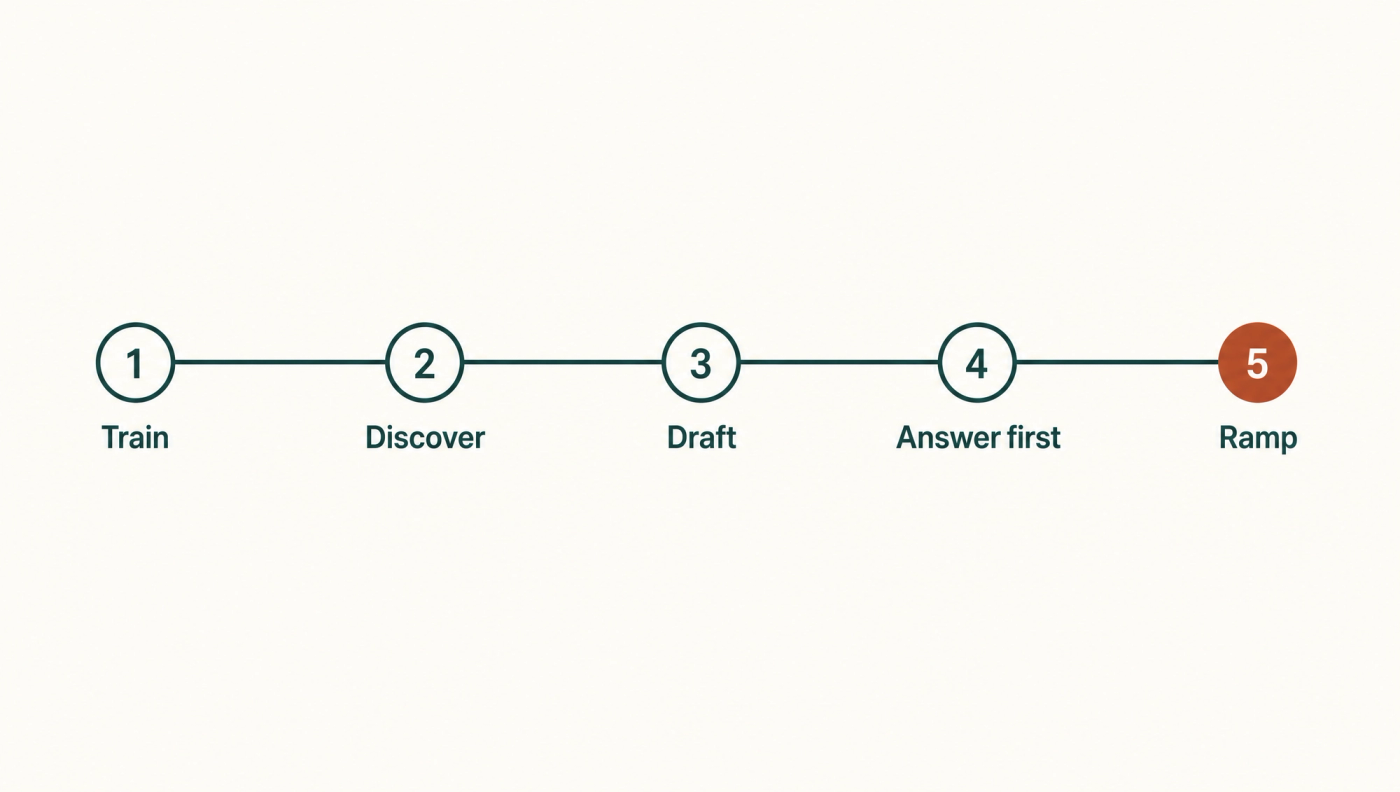
The sequence, in order:
- Train the agent on your brand, so it knows your product, your buyer, and your voice before it writes a word.
- Run keyword discovery against your niche, surfacing the high-intent, low-competition questions your buyers actually ask.
- Generate a starter set of question-and-answer articles, each one owning a single clear question.
- Lead every page with the answer in the first two sentences, so the model can quote it.
- Ramp deliberately on a schedule, rather than dumping everything at once.
Author's tip: write the question as your buyer would say it out loud, then answer it in the first two sentences of the page. AI engines quote pages that lead with the answer, not pages that bury it under three paragraphs of preamble.
Why start slow and ramp up?
You ramp deliberately because a sudden flood of thin content reads as noise to both search engines and AI models, while a steady cadence of genuine answers reads as a live, trusted source. The goal of the starter set is not traffic on day one. It is to give the model something real to surface, then to keep feeding it on a rhythm so each new piece compounds on the last. A deliberate ramp also lets you watch which questions actually get cited and double down, instead of guessing across forty posts you published in a panic.
Adding clear sourcing to your answers compounds the effect. The Princeton-led study that named generative engine optimisation tested nine ways of writing a page and found that adding citations, quotations and statistics lifted a source's visibility in generative answers by up to 40% (Aggarwal et al., 2024). Your starter set should not be ten posts. It should be the five clearest answers to your buyers' first five questions, each one quotable, each one current, published on a cadence you can hold.
Let Apex run your cold start.
Apex, Voho's content agent, trains on your brand, runs keyword discovery to find the few questions worth answering first, and publishes a starter set straight into your CMS, then ramps on a schedule you set. It is the cold-start sequence in this piece, run for you instead of by you.
See how Apex gets you found
Where this leaves you
Getting found by AI from a standing start is not a content marathon. It is a filtering problem followed by a deliberate ramp: train the agent on your brand, find the few high-intent questions, answer them clearly, and publish on a rhythm so the model always has something fresh to surface. The same instinct that pulls a winning prompt out of a chat and saves it as a reusable Skill, a saved prompt your AI tool reads on every run, applies to getting found by AI: do the high-leverage thing once, deliberately, and let it run. If you want the full picture of how models choose who to name, start with what GEO actually is, and if you would rather have a specialist do the answering, our library of ready-made skills shows the same build-once principle in action.
Publish the few clearest answers first. Then ramp.
References
- Ahrefs (2026), 90+ AI SEO Statistics: AI search platforms cite content 25.7% fresher than traditional organic results; 76.4% of ChatGPT's most-cited pages were updated in the last 30 days.
- Nightwatch (2026), Google's AI Overviews: What You Need to Know in 2026: 93.8% of AI Overview linked sources come from outside page one of organic results.
- DemandSage (2026), 50 AI Overviews Statistics: searches starting with a question word return an AI summary 60% of the time; 36% of full-sentence searches do the same.
- Aggarwal et al. (2024), GEO: Generative Engine Optimization (Princeton, Georgia Tech, IIT Delhi and the Allen Institute for AI, ACM KDD 2024): adding citations, quotations and statistics lifts a source's visibility in generative engine responses by up to 40%.
Frequently asked questions
- Why does an empty blog stay invisible to AI?AI assistants answer by retrieving real documents and quoting them, not by inventing recommendations. If your site has nothing that matches the question your buyer asked, you are not in the retrieval set, so you cannot be in the answer. It is absence rather than a penalty.
- How many blog posts do you need to get found by AI?Fewer than most founders assume. A starter set of five clear question-and-answer pages, each owning one specific buyer question and leading with the answer, does more than twenty thin posts chasing broad head terms you will never rank for.
- Does content freshness help a brand-new site get cited by AI?Yes, and it is the one structural advantage of starting from zero. AI search platforms cite content that is 25.7% fresher than the content cited in traditional organic results, and 76.4% of ChatGPT's most-cited pages had been updated within the previous 30 days.
- Should you publish everything at once or ramp up slowly?Ramp deliberately. A sudden flood of thin content reads as noise to both search engines and AI models, while a steady cadence of genuine answers reads as a live, trusted source. A ramp also lets you watch which questions actually get cited and double down on them.
Sources
- Ahrefs (2026), 90+ AI SEO Statistics: AI search platforms cite content 25.7% fresher than traditional organic results; 76.4% of ChatGPT's most-cited pages were updated in the last 30 days
- Nightwatch (2026), Google's AI Overviews: What You Need to Know in 2026: 93.8% of AI Overview linked sources come from outside page one of organic results
- DemandSage (2026), 50 AI Overviews Statistics: searches starting with a question word return an AI summary 60% of the time; 36% of full-sentence searches do the same
- Aggarwal et al. (2024), GEO: Generative Engine Optimization (Princeton, Georgia Tech, IIT Delhi and the Allen Institute for AI, ACM KDD 2024): adding citations, quotations and statistics lifts a sourc