AI Writing Tool or Content Agent? The 5-Minute Decision Test
An AI writing tool like Byword or Koala is the right buy in five specific situations. Here is the five-minute test for whether yours is one of them.


Twenty-five finished articles for $99 a month works out at roughly four dollars each, which is why an AI writing tool looks like the obvious repair for a blog that has gone quiet. The number on the plan is not the price of the outcome: what decides the result is the editorial time you spend after the draft lands, and this piece gives you a five-minute test for whether that time exists. Byword and Koala are both good at the job they were built for, and in several honest situations one of them is the correct purchase. In others, buying drafts nobody will edit builds a backlog with a monthly invoice attached. Score yourself against the conditions below, then buy accordingly.
What does a DIY AI writing tool actually buy you?
A DIY AI writing tool sells you drafts at a fixed price per unit and leaves the editing, the judgement, and the publishing rhythm with you. Byword prices by the article: $99 a month for 25 articles on Starter, $299 for 80 on Standard, $999 for 300 on Scale, with five free articles to test it, and it pushes finished pieces straight into WordPress, Webflow, or Shopify. Koala prices by the word instead, from $9 a month for 15,000 words up to $2,000 for ten million, with a 5,000-word free trial and 20% off annual billing.
Both are genuinely strong inside their lane. Byword's templated bulk generation is the cleanest way to produce hundreds of near-identical pages, and Koala's $9 entry tier undercuts anything a done-for-you service can honestly offer. One caveat is worth knowing before you budget on Koala: word allowances count double when you run the premium models, so a $49 plan buys 50,000 words of the best output rather than 100,000. Neither product pretends to own your calendar, and that is the part worth thinking about.
When is a DIY AI writing tool the right choice?
A DIY AI writing tool is the right choice when the editing capacity already exists inside your organisation. Five conditions make that true, and any two of them together is usually enough.
- You have editorial time. Someone can commit two to four hours a week, and publishing sits inside their actual remit.
- You enjoy the process. Sitting in a draft, changing the argument, rebuilding the outline: some operators want that, and outsourcing it is a loss rather than a saving.
- Volume is spiky. A launch needs 40 pages this month and six next month, which suits per-article pricing far better than a standing monthly fee.
- Budget is genuinely tiny. At $9 or $99 a month you sit below the floor of any managed service, and when cash is the binding constraint that beats every efficiency argument.
- The pages are programmatic. Location pages, comparison pages, integration pages: uniformity is the feature, and a template engine will beat a writer every time.
Please note: these conditions describe capacity, not ambition. Wanting to edit is not the same as having diary space to edit, and the plan you buy in January gets judged by what you published in June.
When should you hand the whole job to a content agent?
Handing the whole job to a content agent makes sense when nothing about your week is going to change to make room for editing. A content agent is an AI system built for one brand that researches, writes, and publishes into that brand's CMS on a schedule, rather than a product you log into and operate. Voholabs runs one called Apex: £799 to build and calibrate it against your existing published work, then £239 a month to host and run it. That sits above Byword's Starter tier and well under an agency retainer, and what the money buys is published pages you never touched.
Four conditions point this way: nobody owns the content calendar, so drafts accumulate unread; your cadence keeps slipping, and the thirty pieces you meant to publish this year came out as three; the pages carry your name in front of buyers, so output that reads like everyone else's costs more than it saves; and you want an asset rather than a task, because a published page compounds where a draft only waits.
Filter the noise before you buy. If you cannot name the person who will edit, a per-article price is the most expensive option on the table. Apex studies your existing published work, learns the voice, and ships pages into your CMS on a schedule.
The five-minute decision test
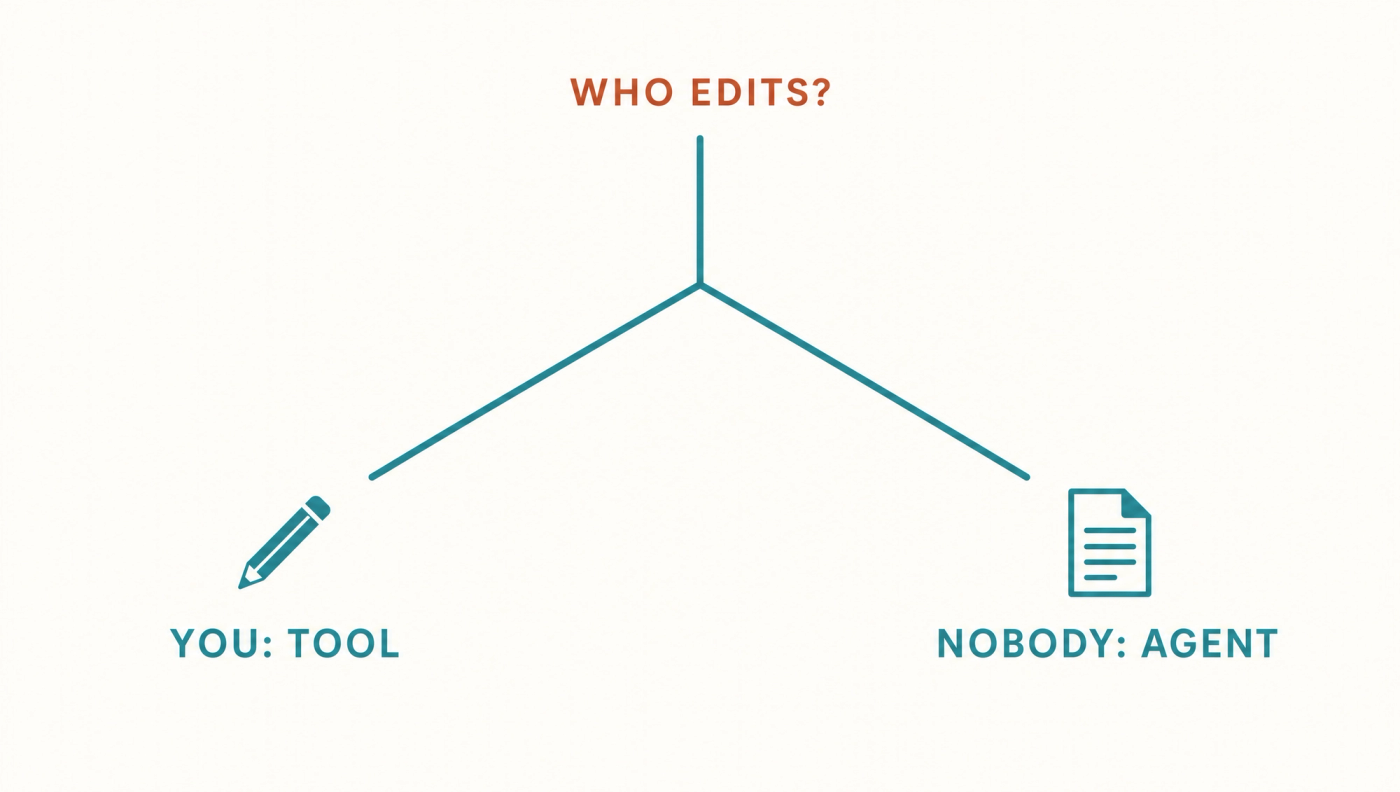
Five questions decide this, and each one scores a point to either the tool column or the agent column.
- Who edits, by name? A named person scores the tool. A shrug scores the agent.
- How many pieces went live in the last 90 days? Eight or more scores the tool. Fewer than four scores the agent.
- Is the volume spiky or steady? Bursts around launches score the tool. A weekly cadence scores the agent.
- Do these pages carry your brand in front of buyers? Programmatic pages score the tool. Your shop window scores the agent.
- What is the monthly budget? Under £150 scores the tool. £200 or more scores the agent.
Three or more in the tool column means buy Byword or Koala this week and use it properly. Three or more in the agent column means the tool will not fix the problem, because drafting was never the part that was missing.
Author's tip: run this test against last quarter's actual publishing record, not against your plan for next quarter. The record is the only honest input.
That score also names the stage you are at. In the AI-enabled stage the tools are open and nothing compounds, with prompts scattered and drafts unfinished. Codify the process that works so it repeats the same way every time, and you are AI-first. When the publishing loop runs without you standing in it, the work has gone AI-native. A writing tool holds you at the first stage unless you personally supply the editing; a content agent moves the loop itself.
What does the ranking data say about unedited drafts?
Unedited AI output is a poor bet in search, and the gap is wide enough to plan around. Semrush analysed 42,000 blog posts across 20,000 keywords and surveyed 224 SEO professionals for its April 2026 study, and found purely AI-generated pages holding the number one position about 9% of the time against roughly 80% for human-written pages, an eight-fold difference. The same research put 87% of SEO teams in fully human or heavily human-led workflows, with 64% running a human-led, AI-assisted process.
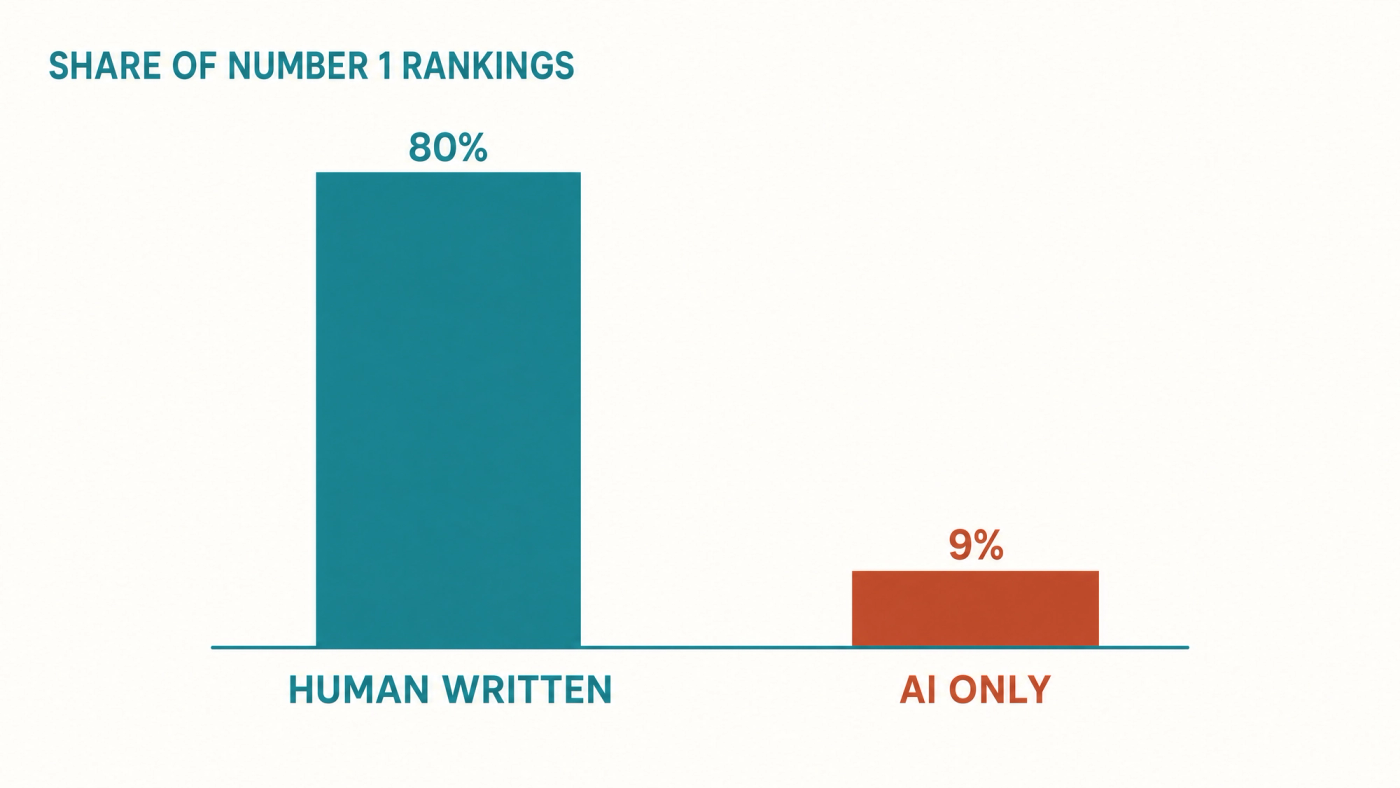
Detection tools are imperfect and the study says so plainly, yet the direction holds: the human pass separates a page that ranks from a page that merely exists. That pass comes from your diary or from somebody else's system, and pretending otherwise is how a $99 plan turns into 25 unread drafts.
Where this leaves you
The tool and the agent solve different halves of the same job. A tool gives you drafts cheaply and asks for your hours; an agent gives you published pages and asks for a budget. Noise Filtering, one of the two things Voholabs does, means cutting the AI landscape down to what is actually relevant to your situation, and the filter here is a single question: can you name the person who will edit? If you can, buy the tool today and run it hard. If you cannot, Apex was built for exactly that gap. Take the five-minute test now. Then buy once.
References
Frequently asked questions
- Is Byword or Koala better value?They price different units, so the answer depends on your shape. Byword sells articles ($99 a month for 25, $999 for 300) and suits high-volume programmatic publishing. Koala sells words (from $9 a month for 15,000) and suits a mixed workload on a small budget. Neither removes the editing, which is the cost that actually decides the outcome.
- Do I still need to edit content from an AI writing tool?Yes, and the data is blunt about it. Semrush found purely AI-generated pages holding the number one position about 9% of the time against roughly 80% for human-written pages, across 42,000 blog posts analysed in 2026. Budget the editing time before you budget the subscription.
- What is a content agent and how is it different from an AI writing tool?A content agent is an AI system built for one brand that researches, writes, and publishes into that brand's CMS on a schedule. An AI writing tool is a product you log into and operate, and it hands back drafts. The difference is who finishes and publishes the work: the agent does, the tool leaves it to you.
- How much does a content agent cost compared with an AI writing tool?Voholabs prices Apex at £799 to build and calibrate the agent, then £239 a month to host and run it. That is more than Byword's $99 Starter tier and a fraction of a typical agency retainer. You are paying for published pages rather than drafts, so compare it against your own editing hours, not against the tool subscription alone.
Sources
- Byword AI Pricing· Byword
- Integrations· Byword
- Koala AI Pricing· Koala
- Does AI content rank well in search? Semrush (2026)
- Human content is 8x more likely than AI to rank #1 on Google· Search Engine Land