Why 88% of Enterprise AI Agents Get Breached in 2026 (And the 4 Fixes)
Eighty-eight percent of enterprises had an AI agent incident this year. Four guardrails on enterprise AI agents in 2026 that actually catch a rogue one.

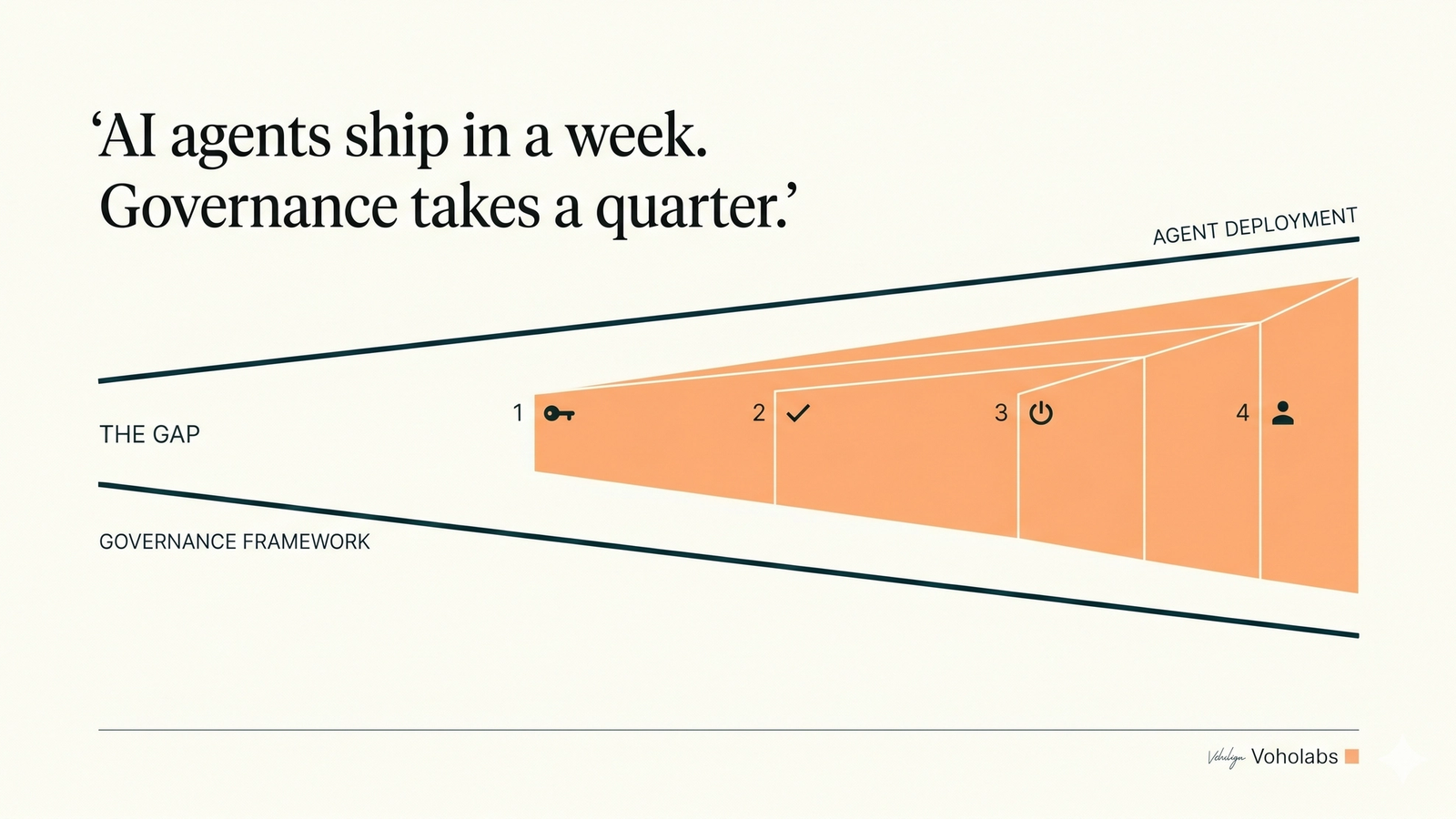
Eighty-eight percent of enterprises had an AI agent security incident in 2026. Eighty-two percent of executives say their current policies protect them. The gap between those two numbers is where the work sits this quarter.
If you are the senior operator scaling enterprise AI agents in 2026 across three or four functions, you already know the timing problem. Agents take a week to ship. Governance frameworks take a quarter to draft. The work an operator can do directly, this quarter, lives in the gap between them.
This piece filters the noise: four guardrails that actually catch a rogue agent, and one move per guardrail you can ship this quarter.
Why enterprise AI agents in 2026 outrun their guardrails
Enterprise AI agents in 2026 are reaching production faster than the controls meant to govern them. Deloitte's 2026 State of AI report puts mature agent governance at 21 percent of organisations, against 80.9 percent of technical teams already in active deployment. Only 14.4 percent of those deployments shipped with full security and IT approval. CISA, the NSA and Five Eyes partners published Careful Adoption of Agentic AI Services on 1 May 2026, naming the same gap.
The cause is sequencing. Buying an agent takes a week. Standing up a governance framework takes a quarter. By the time the framework lands, it is a long document no one on the operating team can act on by Monday.
Guardrail one: least-privilege access
Least-privilege access cuts the incident rate for enterprise AI agents in 2026 from 76 percent to 17 percent. Gravitee's 2026 State of AI Agent Security report shows the contrast directly: agents granted only the permissions their task needs have a roughly fourfold lower incident rate than agents given the full access of the human who provisioned them.
The default state for most rollouts is the opposite. The agent inherits the credentials of whoever set it up, which usually means an operator with the keys to the system. The agent can read everything, write everything, call any internal API. When it goes wrong, the blast radius is the credentials, not the task.
The one move: before you ship the agent, write down the minimum set of actions it needs, and provision it against that set. A ticket summariser does not need write access to the CRM. An email drafter does not need read access to financial reports. Cut the access at the start, not after the breach.
Guardrail two: observability with evaluation, not just logs
Observability without evaluation is monitoring you cannot interpret. LangChain's 2026 State of Agents survey found 89 percent of respondents had implemented agent observability, but only 52 percent had implemented evaluations. The first number says the agent is being watched. The second says whether anyone can read what they are watching.
Most enterprises have the first half. The runs are logged. The tool calls are captured. The dashboard is full. None of it answers the question that matters when something goes wrong: was the agent doing the right thing for the right reason, or was it confidently doing the wrong thing?
The one move: pair every observability tool you ship with one automated evaluation against ground-truth examples. Logs without evals is watching without seeing.
Guardrail three: a kill switch you have actually tested
A kill switch only counts when you have used it. Thirty-five percent of executives in the 2026 Deloitte survey admitted they could not immediately pull the plug on a rogue agent. The other 65 percent largely believe they can. The believing is the problem. A kill switch you have never run is a kill switch you do not have.
The blast radius of an agent that cannot be stopped is not theoretical. Autonomous agents now account for one in eight reported AI breaches in 2026. The cases that ended worst share one detail: the team noticed the bad behaviour, then took hours or days to actually stop it.
The one move: schedule a 30-minute drill for each production agent this quarter. Trigger the kill switch in a controlled window. Time how long it takes for the agent to stop, for downstream systems to register the stop, and for a human to confirm. If any step is longer than two minutes, that is your gap. Fix it before the day you need it.
Guardrail four: human approval at high-blast-radius steps
Approval gates at high-blast-radius steps keep autonomy from becoming abdication for enterprise AI agents in 2026. The CISA agentic AI guidance, published with the NSA and Five Eyes partners on 1 May 2026, names identity controls, approval gates, audit logs, rollback and human override as part of whether the deployment is viable at all, not optional polish.
The mistake most enterprises make is binary. The agent is either fully autonomous or it requires a human for every action. Neither works. Full autonomy creates lateral risk: a compromised agent can hand bad instructions to a downstream agent and escalate. Full review creates the bottleneck that killed every previous wave of automation.
The one move: list every action your agent can take. Mark the ones with high blast radius, the irreversible changes, external sends, financial actions, anything touching a customer. Require human approval for those, and only those. Let the agent run autonomous on the rest. The blast-radius map is what your governance memo should have been.
Where this leaves you
By end of quarter, you should have one of the four in place. Pick the guardrail closest to your worst case. If your agents touch customer data, start with least-privilege access. If they make outbound decisions on your behalf, start with the blast-radius map. If you do not know what they are doing, start with evaluation.
Most enterprises rolling out enterprise AI agents in 2026 are AI-enabled. AI-enabled means the tools are open and the agents are running, but nothing compounds across them: the lessons from one rollout do not improve the next, and a rogue agent cannot be stopped quickly. The four guardrails above are the move from AI-enabled to AI-first, where you intentionally build on AI, every rollout codifies what worked, and each agent ships cheaper and safer than the last.
The logic that makes individual AI work compound applies to agent rollouts too.
Cut the noise on your own rollout
Voholabs runs noise-filtering audits for senior operators rolling out enterprise AI agents in 2026. We surface the three or four moves that change your incident rate this quarter.
Book an audit
Ship one guardrail this week. Not next quarter.
Frequently asked questions
- What is the single most effective guardrail for an AI agent?Least-privilege access. Giving an agent only the permissions it needs cuts incident rates from 76 percent to 17 percent, more than any other single control, because it shrinks what a rogue agent can reach.
- Why do enterprise AI agents get breached despite existing policies?Because the policies are assumed, not tested. 88 percent of enterprises had an agent incident in 2026 while 82 percent of executives believed their policies protected them. Guardrails only count once you have used them.
- How do I know my kill switch actually works?Run it. A kill switch you have never triggered is a hope, not a control. Schedule a 30-minute drill on every production agent this quarter and confirm it stops the agent mid-task.
Sources
- State of AI in the Enterprise 2026· Deloitte
- State of AI Agent Security 2026: When Adoption Outpaces Control· Gravitee
- A Guide to Agentic AI Risks in 2026· Strata
- AI Agent Security Vulnerabilities 2026· AI Automation Global