Surfer vs Frase vs Clearscope: 2026 Pricing (And When to Skip All Three)
Surfer, Frase, and Clearscope start at $49, $39, and $129 a month in 2026. Here is what each one caps, who each fits, and when a score is not your bottleneck.


By Mehrdad Sadeghi, July 2026, 6 min read
Three content optimisation tools sit on almost every shortlist, and as of July 2026 their entry prices are $39, $49, and $129 a month. Surfer vs Frase vs Clearscope is a real decision with a real answer, because the three meter themselves very differently below the headline price, and this piece gives you that answer on cost, caps, and fit. All three solve one problem: nobody can tell whether a draft will rank until it is live, so each supplies a live content score and a brief built from the pages already ranking. For a team with writers producing, that is the right buy. The harder question comes after, because a score only measures work that exists.
What do Surfer, Frase, and Clearscope actually do?
All three read the pages currently ranking for your target keyword, extract the terms, headings, and length those pages share, and grade your draft against that pattern while you write. What you get back is a number to chase and a list of terms you are missing, which is genuinely useful when the writer is not a search specialist. The emphasis then differs. Surfer leans hardest on the on-page editor: term list, word count target, heading targets, and a score that moves as you type. Frase built its name on research and brief building, and in 2026 it also publishes into WordPress, Webflow, Sanity, or Wix and tracks how often AI assistants mention you. Clearscope is the editorial one, producing a graded report an editor can hand to a freelance writer with no explanation attached. Against the wider choice between a tool you operate, an agency you brief, or an agent that does the job, all three sit in the first category, and all three assume you already have someone writing in your brand voice.
How do Surfer vs Frase vs Clearscope compare on price in 2026?
Headline prices are close and the limits are not. Here is what each self-serve tier buys, taken from the three live pricing pages in July 2026.
- Frase. Starter $49 a month or $39 on annual billing: 1 seat, 1 site, 10 articles a month. Professional $129 or $103 annual: 3 seats, 5 sites, 40 articles. Scale $299 or $239 annual: 5 seats, 10 domains, 100 articles. Extra seats cost $29 a month. The cap that bites is articles per month.
- Surfer. Discovery $49 a month billed yearly: 1 seat, 120 documents, 10 pages tracked. Standard $99: 1 seat, 360 documents, 25 AI prompts. Pro $182: 5 seats, 200 pages, 50 AI prompts. Peace of Mind $299: 10 seats, unlimited documents, 500 pages. Enterprise from $999. The cap that bites is seats, one until you reach Pro.
- Clearscope. Essentials $129 a month: unlimited users and projects, 20 drafts, 50 pages, 50 tracked prompts. Business $399: 300 pages, 300 tracked prompts, 50 topic explorations, still 20 drafts, plus a dedicated account manager. Enterprise is custom, with SSO. The cap that bites is drafts.
Two details matter more than the plan names suggest. Surfer's credits reset yearly according to its own pricing FAQ, so Discovery's 120 documents is about 10 a month and Standard's 360 is about 30, much closer to Frase than the raw count implies. Clearscope charges nothing per seat, so its $129 floor covers a founder, an editor, and every freelance writer on one bill.
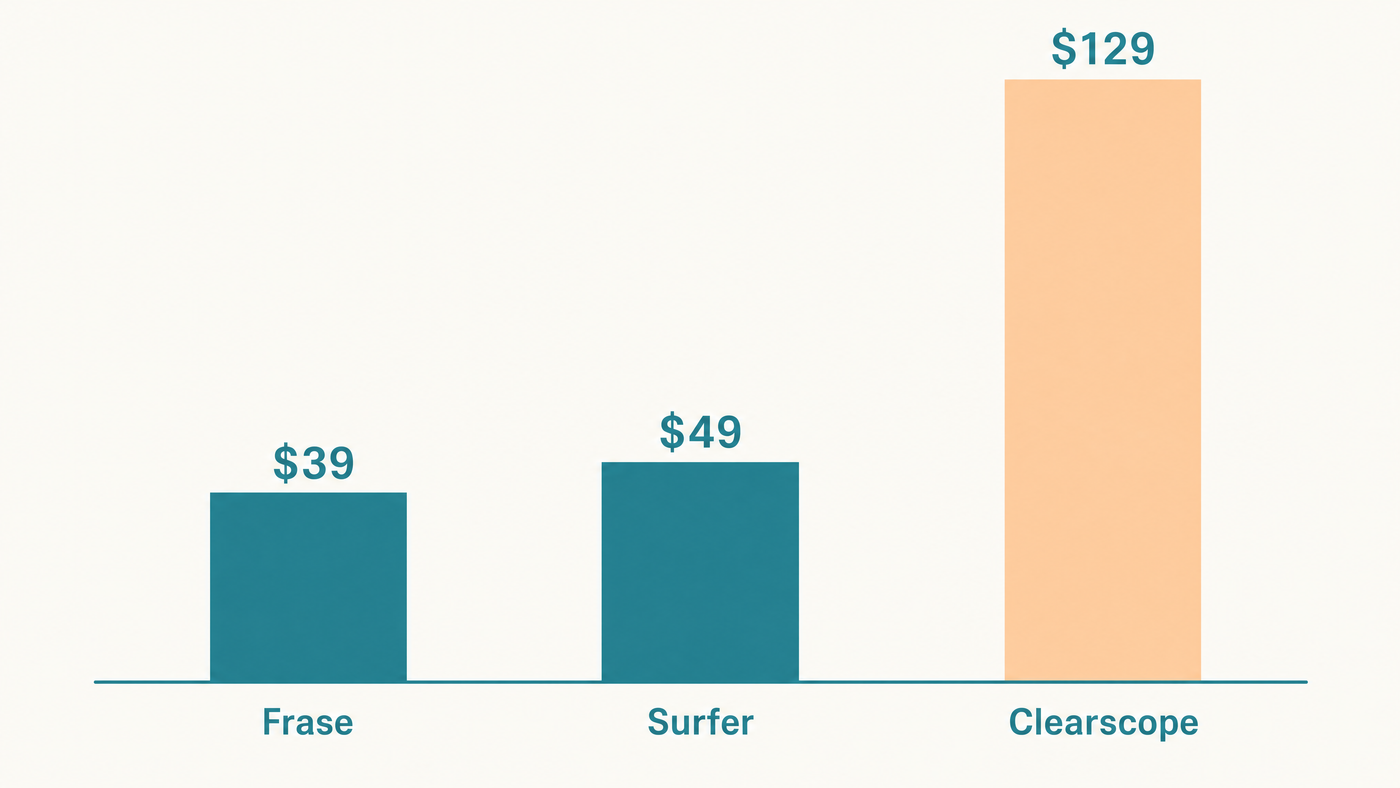
The key difference is: Frase and Surfer meter volume and charge for people. Clearscope gives away people and meters volume hard. Which of those hurts depends entirely on the shape of your team.
Which content optimisation tool fits which team?
Pick on the constraint that bites first: how many people touch a draft, how many drafts you publish, how many domains you run. A solo operator on one site publishing fewer than ten articles a month is best served by Frase Starter at $39 annual, the only entry tier that closes the loop from research through to a published post. Where the work is optimising a large back catalogue instead, Surfer Discovery at $49 wins on the editor itself. Clearscope earns its higher floor the moment freelancers get involved, because six people cost $182 a month on Surfer Pro and $103 annual plus $29 a seat past three on Frase, while Clearscope charges the same $129 whether one person logs in or twenty. Agencies running ten client domains have two workable options, Frase Scale at $239 annual or Surfer Peace of Mind at $299.
On the job all three were built for, they beat what we do. Apex, our content agent, shows you no score and no term list to chase, so if your writers want that feedback loop, one of these three is the correct purchase. The comparison only turns when the writers are not there, which is the same line that separates a templated SEO platform from a custom agent, and the same reason the economics of an owned content asset look different from a subscription's.
When does a content score stop being the bottleneck?
A content score measures a draft that exists, and does nothing about the drafts that never got written. That distinction decides whether $129 a month is the best money you spend this year or the most expensive dashboard you ignore. The second case is common. Resource constraints, meaning time, people, and budget, were the second most cited content challenge among 1,015 B2B marketers surveyed by the Content Marketing Institute for its 2026 outlook, named by 39%. Ahrefs found that 96.55% of roughly 14 billion pages it indexed get zero traffic from Google, and a great many of those pages were optimised before they were abandoned.
Run four questions before you spend anything:
- Did you publish at least four articles last month?
- Is there a named person whose job includes writing them?
- When a draft scores 62, does someone have the hours to take it to 85?
- Is your traffic problem the quality of what you published, or the volume you never got to?
Three yeses and a quality answer to the fourth means buy the tool that matches your team shape from the section above. Two or fewer means the score is not your constraint, because a better score on an article that does not exist is worth nothing. That filtering is what we call Noise Filtering: cutting the AI landscape down to the few moves that apply to your situation, and refusing the rest.

Please note: all three now track AI visibility, Surfer and Clearscope through tracked prompts and Frase through its AI Visibility reporting. Being cited by an assistant is a different job from ranking, covered in what generative engine optimisation actually is and in how SEO, AEO, and GEO fit together.
What does it cost to buy the whole job instead?
Apex is a content agent: a custom AI agent that researches topics in your niche, writes in your brand voice, and publishes straight into your CMS, at £799 to set up and £239 a month to run. No score appears because no draft sits waiting on a human. Against these three tools that is not the cheaper option, and pretending otherwise would be dishonest: Clearscope Essentials at $129 costs less every month, Frase Starter at $39 a great deal less. Apex is cheaper than an agency retainer, where £799 and £239 sits well below what a UK content agency charges to produce and publish four articles a month. The unit changes. A tool sells you a score and you supply the writing; Apex sells you the published article, on your own blog rather than a rented platform.
This is also where the three AI stages land. A team is AI-enabled when the tools are open and the humans still do the work, which is exactly where a content score sits: useful, and dependent on someone showing up with a draft. AI-first is the stage above, where the repeatable parts have been codified so they run the same way twice. AI-native describes a workflow that only exists because AI exists, with nobody waiting on a human draft. An optimisation tool moves a good writer up one stage, and it cannot move an empty pipeline anywhere.
Stop grading drafts that were never written. Voholabs builds Apex for one brand at a time: your niche, your voice, your CMS, publishing on a schedule you set. See how a content agent captures the buyers already searching, then book a call with Voholabs.
Where this leaves you
Surfer, Frase, and Clearscope are three good answers to one question: how to make a draft rank once a human has written it. Frase is the cheapest complete loop for a solo operator, Surfer has the sharpest editor, and Clearscope is the only one a whole editorial team can share on one bill. Buy one if your writers are producing and the score is what stands between a draft and page one. Ask the four questions before you commit to anything. If the honest answer is that the articles are not being written, no score fixes that, and an agent that researches, writes, and publishes without a human draft is the move instead. Fix the empty pipeline first.
References
Frequently asked questions
- Which is cheapest: Surfer, Frase, or Clearscope?Frase Starter is the cheapest at $39 a month on annual billing, against $49 for Surfer Discovery and $129 for Clearscope Essentials. Cheapest is not the same as best value: Frase Starter caps you at one seat, one site, and 10 articles a month, so your real cost depends on how many people and domains you run.
- Is Clearscope worth $129 a month when the other two start lower?It is once more than two people touch a draft. Clearscope charges nothing per seat and allows unlimited users and projects on every self-serve plan, so a founder, an editor, and four freelancers share one $129 bill. The same six people cost $182 a month on Surfer Pro.
- Do I need a writer to get value from a content optimisation tool?Yes. All three grade a draft that already exists, so they assume someone is producing the words. If nothing is being written, the score has nothing to measure and the subscription earns nothing back.
- How does Voholabs Apex compare on price to these tools?Apex costs £799 to set up and £239 a month, which is more than Clearscope Essentials or Frase Starter and well below a UK content agency retainer. You are buying a different unit: Apex researches, writes in your brand voice, and publishes the article rather than scoring one you wrote.
Sources