Content Marketing Agency Cost in 2026 (And the £24 Article Alternative)
Content marketing agency cost runs from $1 a word to $8,000 a month. Here is the same job priced per published article, and where an agency still wins.


Brafton prices content creation in units of 100 words at $100 a unit, which is a dollar a word, so a 1,500-word article runs to $1,500 before anyone designs a graphic for it. Siege Media's stated minimum is $8,000 a month on a twelve-month contract. Those are fair prices for what those teams produce, and they are also why the average marketing budget buys four articles a month rather than twenty. When the problem is cadence rather than a single flagship asset, the content marketing agency cost is the wrong shape, and a custom content agent at £799 to build plus £239 a month to run does the volume work at roughly £24 per published article. This piece does the arithmetic both ways and names the jobs where an agency still wins outright.
What does a content marketing agency cost in 2026?
A content marketing agency in 2026 prices either by the word or by a monthly minimum, and both routes put a single well-made article somewhere between $1,500 and $6,000. Brafton publishes its unit model openly: content creation at $1 a word, technical SEO consulting at $200 an hour, search performance briefs at $300 apiece. Siege Media is retainer-shaped instead, with content marketing minimums "currently $8,000 per month" and a twelve-month contract carrying a 30-day exit clause. Their own cost guide puts a high-impact blog post at $1,500 to $6,000 and a full campaign for a mid-sized business at $10,000 to $20,000 a month.
Verblio sits lower on the same shelf, at $0.16 a word for 100% human content and $0.06 a word for its AI-plus-human tier with a $49.50 monthly platform fee. For a team that wants two solid pieces a quarter, that is hard to beat on price.
Converting at the 20 July 2026 rate of 0.7439 US dollars to the pound, here is the same question asked as cost per published article, at a cadence of twelve 1,500-word pieces a month.
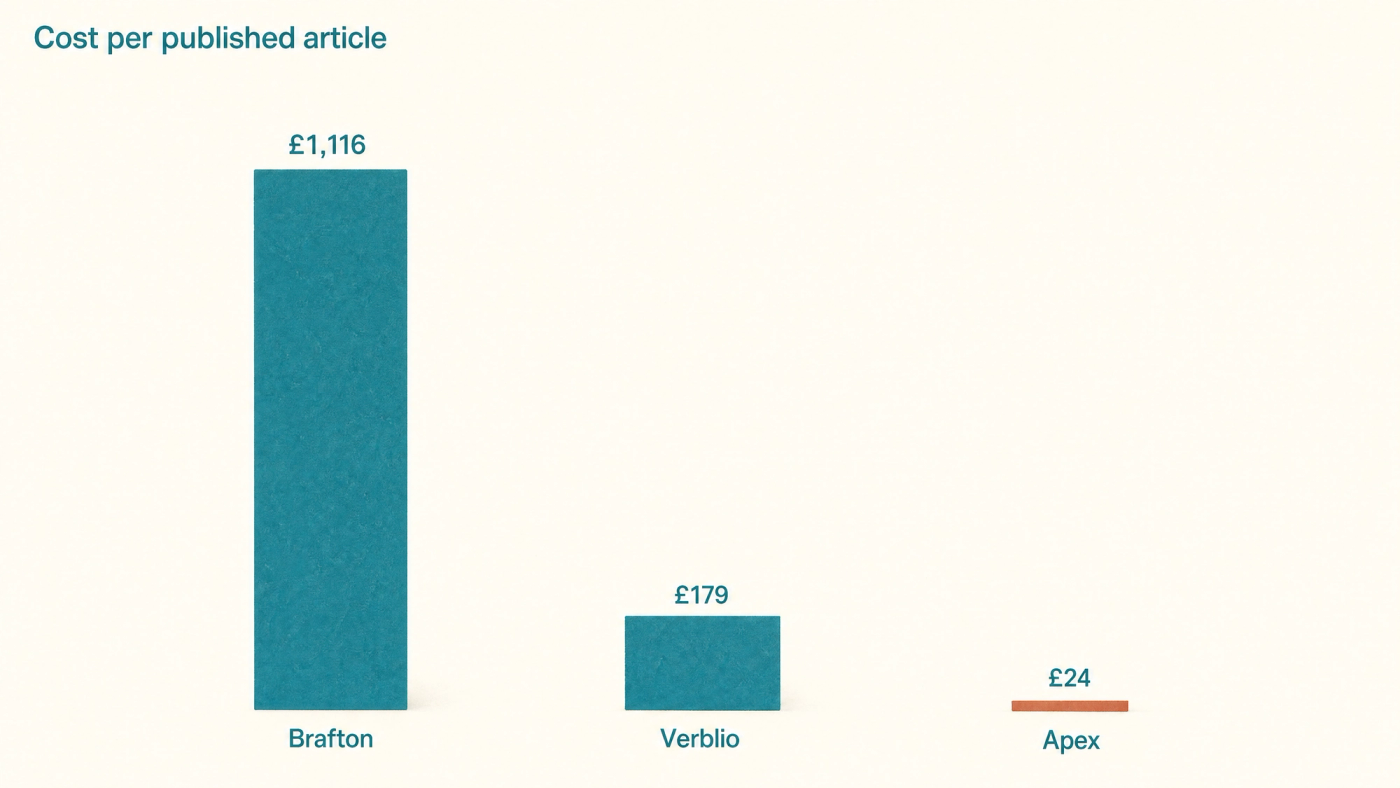
- Brafton at $1 a word: $18,000 a month, about £1,116 per article.
- Siege Media at its $8,000 monthly minimum: 1 to 5 posts at their own per-post range, about £1,190 to £5,951 per article.
- Verblio's 100% human tier at $0.16 a word: $2,880 a month, about £179 per article.
- Verblio's AI-plus-human tier at $0.06 a word plus the $49.50 platform fee: $1,129.50 a month, about £70 per article.
- Apex, a custom content agent, at £799 setup and £239 a month: about £24 per article in year one.
The spread across those five figures is the whole argument, so it is worth being precise about what sits behind the last one.
What does a custom content agent cost per published article?
A content agent is a single AI agent built for one brand that researches topics, writes in that brand's voice and publishes into that brand's CMS on a schedule, and its price does not move with volume. Apex, the agent Voholabs deploys, costs £799 once to build (niche and competitor mapping, CMS integration, voice calibration, first month of running included) and £239 a month after that for hosting, model costs and daily operation. A £0 self-serve tier hands over the code, prompts and configuration so you can run the infrastructure yourself.
Year one is therefore £799 plus eleven further months at £239, which is £3,428. Publish three pieces a week and that is 144 articles at £23.81 each. Drop to one a week and it is £65.92 each. Nothing about the invoice changes, only the divisor. That is a different question from whether content or paid ads earn the budget, and different again from which category of supplier you are shopping in.
The key difference is: an agency charges for each article it produces, while a content agent charges for the month regardless of how many pieces run through it. Every additional piece lowers your cost per published article instead of raising your invoice.
Honest boundary: below roughly one and a third articles a month, per-word marketplace pricing beats a flat monthly fee. Verblio's human tier at 1,500 words is about £179 a piece, so if you publish once a month you should pay them and not us. Above that line the flat fee wins and keeps widening the gap.
Where does a content agency genuinely beat a content agent?
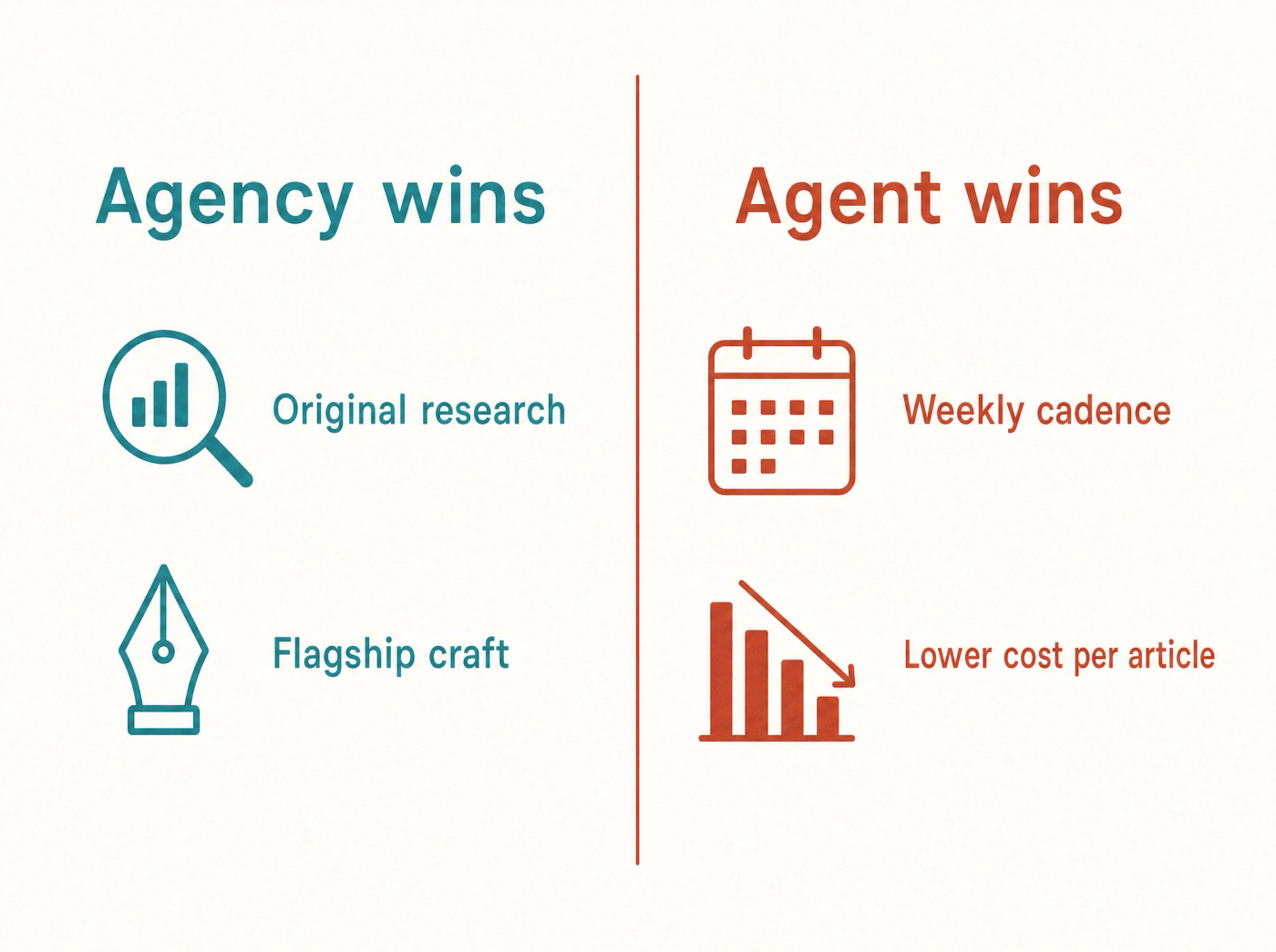
An agency beats a content agent at anything that happens once and has to be extraordinary. Original research is the clearest case. Siege Media's whole economic engine is data studies and digital PR that earn links, and they cite 1,580 links generated for one insurance client and a 657% rise in organic traffic for another. No agent is going to survey 2,000 people, commission a photographer, or talk a journalist into the story.
Bespoke design and video is the second. Brafton runs in-house design, interactive infographics, animation and full video production, and Siege's own guide prices a two-minute video near $7,000 and a unique interactive at $5,000 or more. That work is craft, and craft is bought by the hour from people who have done it before.
The third is senior strategy with a name attached: someone who sits in your quarterly review, argues the case in front of your finance director, carries the relationships that turn a good asset into a placed one, and picks up the phone when the quarter is going badly. If your next twelve months hinge on one flagship asset a quarter, pay the retainer. An agency will do that better than any agent will this year.
Why does a brand-trained agent win on cadence and consistency?
A content agent wins wherever the work is repetitive, high-volume and has to sound identical every single time, which is most of a content programme. It is also where human retainers get expensive fastest, because every article costs a fresh brief, a fresh writer and a fresh round of edits.
Customization, in the sense Voholabs uses it, means the system is built around your specifics rather than a shared template everyone else logs into: your voice, your buyers, your CMS, your budget, your model. Apex learns tone from your existing published content, which is the fix for AI output that reads like everyone else's, and that training is the line between a custom agent and a templated platform you operate yourself. It publishes straight into your CMS, live or queued as drafts for approval, so the work lands on the asset you own rather than waiting for someone's Thursday afternoon.
There is a staircase behind this. AI-enabled means drafting in a chat window and pasting the result into the CMS by hand. AI-first means codifying what works into something that runs without you steering every step. AI-native means the publishing pipeline itself only exists because AI does. Handing the whole research-write-publish loop to a trained agent is the step onto that third stair, and it is the same move that makes you visible in AI answers as well as in search results.
Cut the cost per published article, not the standard. Apex is built for one brand, trained on your voice, and publishes on your schedule for £799 to set up and £239 a month. See how Apex works at voholabs.com.
How do you choose between an agency retainer and a content agent?
Five questions settle it, and they take about ten minutes to answer honestly.
- Does the next twelve months hinge on one flagship asset or on fifty ordinary ones? Flagship points to the agency.
- Do you need original data, digital PR, photography or video? That is agency work, today and probably next year.
- Do you already know your topics, your buyers and your angles? If yes, you are paying an agency mostly for typing.
- Is your bottleneck production rather than ideas? An agent removes production; it does not replace judgment.
- Are you publishing fewer than two pieces a month? Pay per word and skip the flat fee entirely.
Please note: running both is the normal answer at any serious budget. The agency builds the two or three flagship assets a year, and the agent holds the weekly cadence in between so the site is never quiet for a fortnight.
Where this leaves you
The content marketing agency cost is not unfair, it is priced for craft, and craft is the wrong thing to buy by the dozen. If you need fifty pieces a year in a consistent voice, published on time, the arithmetic runs from about £1,116 an article down to about £24, and the only thing you give up is flagship work you should be buying separately anyway. Voholabs builds Apex for one brand at a time, tunes it to your voice and your CMS, and hands you the agent rather than another login.
Work out your own cost per published article this week. The number usually decides it.
References
Frequently asked questions
- How much does a content marketing agency cost in 2026?Published rates put a single well-made article between $1,500 and $6,000. Brafton charges $1 a word, so a 1,500-word piece is $1,500. Siege Media works on retainer instead, with a stated minimum of $8,000 a month on a twelve-month contract that carries a 30-day exit clause.
- Is a custom content agent cheaper than a content marketing agency?At volume, yes. A content agent is priced by the month rather than by the article, so at £799 to build and £239 a month, twelve pieces a month works out near £24 each in year one. Below roughly one and a third articles a month, per-word pricing from a marketplace like Verblio is cheaper.
- What can a content marketing agency do that an AI content agent cannot?Original research, digital PR, photography and video, and senior strategy with a named person accountable for it. Siege Media's model is built on data studies that earn links, and Brafton runs in-house design and video production. An agent will not survey 2,000 people or place a story with a journalist.
- Can you use a content agency and a content agent together?That is the usual answer at any serious budget. The agency builds the two or three flagship assets a year, and the agent holds the weekly publishing cadence in between so the site is never quiet for a fortnight.
Sources
- Brafton· SEO Plans and Pricing
- Siege Media· Content Marketing Services
- Siege Media, How Much Does Content Marketing Cost in 2026? (2026)
- Verblio· Pricing
- ExchangeRate-API, USD reference rates, 20 July 2026