Byword Alternative: 300 Programmatic Pages or Brand-Trained Articles
Byword alternative or Byword itself: current 2026 pricing, the programmatic jobs Byword wins outright, and when a brand-trained content agent is the better buy.

Byword's top self-serve plan publishes 300 articles a month for $999. Apex, the content agent Voholabs builds, publishes fewer than that, in one brand's voice, for a one-time £799 and £239 a month. Both are real answers, and they answer different questions, so buying the wrong one costs you twice: once on the invoice, once on the pages nobody reads. Looking for a Byword alternative makes sense when the job is a voice a reader recognises. Byword itself is the better buy when the job is coverage, hundreds of near-identical pages generated from a spreadsheet, each aimed at one long-tail query. Here is the split, with current prices on both sides.
What does Byword cost and what do you get?
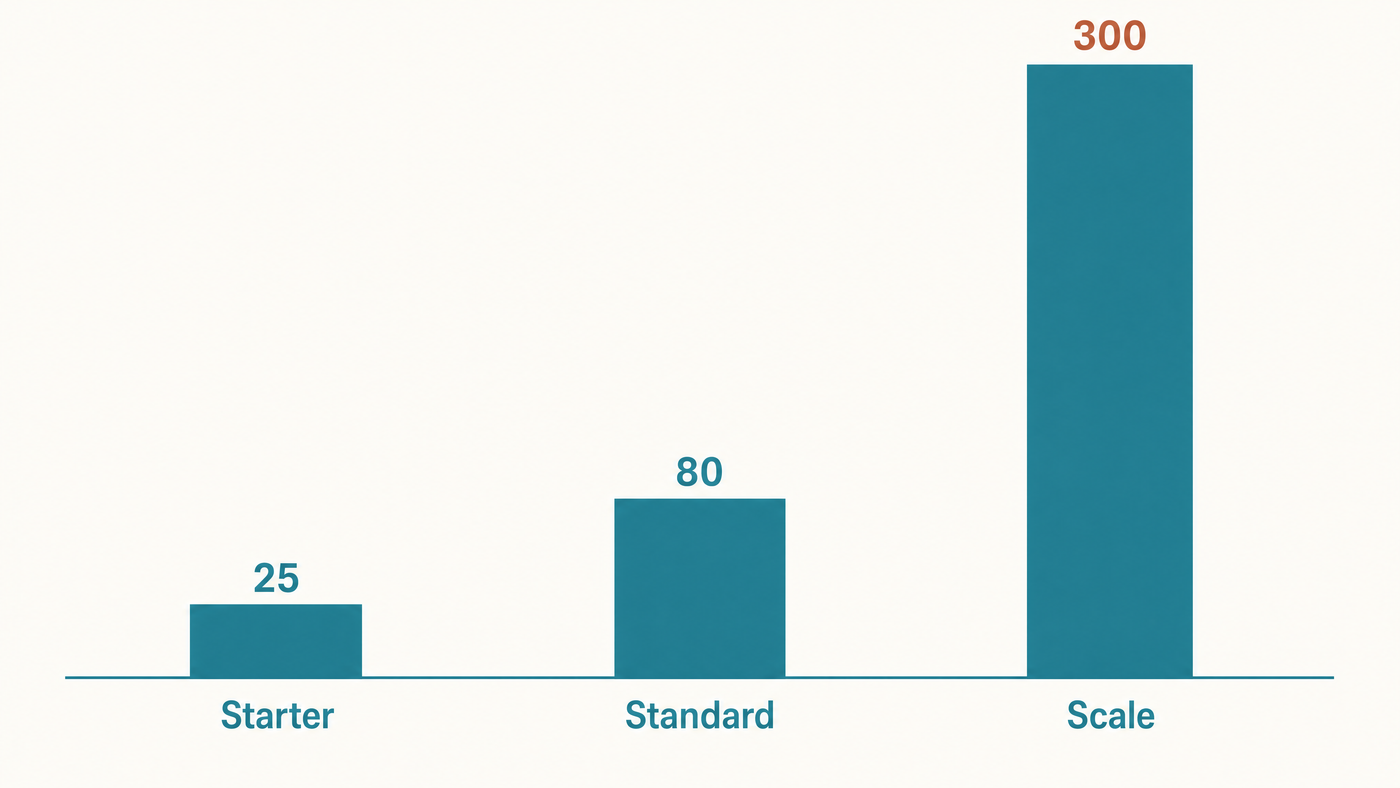
Byword is a self-serve AI article generator priced by article volume, running from $99 to $999 a month. Starter is $99 a month for 25 articles, Standard is $299 a month for 80, and Scale is $999 a month for 300, with five free articles at signup so you can test it before paying (Byword, 2026). Byword says it generates an SEO-optimised article in under two minutes, runs on current frontier models, and publishes into WordPress, Webflow, and four more content systems (Byword, 2026). You feed it keywords or titles in bulk through its campaign builder, and it writes and ships. At the Scale tier that is roughly $3.33 an article.
What is a brand-trained content agent?
A brand-trained content agent is an agent built for one brand, trained on that brand's own published archive, that researches, writes, and publishes into that brand's CMS without the buyer operating a platform. Apex is the one Voholabs deploys: £799 one-time setup, then £239 a month covering hosting, model costs, and daily operation. The setup fee buys the part a platform cannot sell you, which is calibration against your existing writing, your buyers' real questions, and your CMS.
Generic AI content reads the same everywhere because the structure is shared across every customer of the platform producing it. An agent trained on one archive is built around the questions your buyers actually ask, and it publishes for you rather than handing you a login.
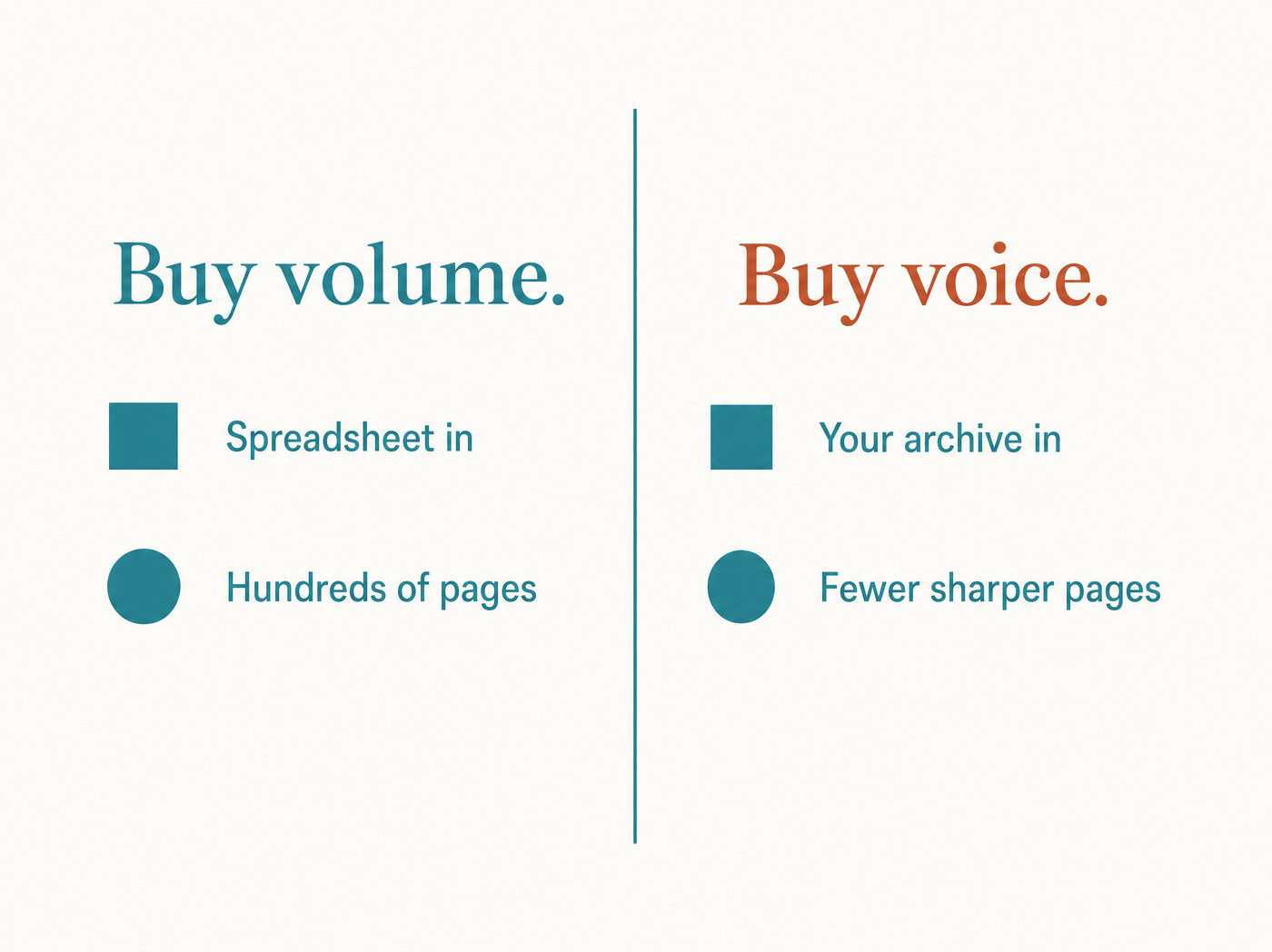
The key difference is: Byword sells article volume at a price per article, while a brand-trained agent sells a voice that carries across every article it writes.

When does Byword win?
Byword wins when your job is coverage and the pages are structurally similar to one another. Programmatic SEO, building many pages from one repeatable template and a data set, is the clearest case: location pages, integration pages, comparison matrices, anything where the value sits in the spreadsheet row rather than the argument in the prose. Byword turns that spreadsheet into published pages in bulk, and cheaply.
On sticker price it beats a custom agent outright. $999 for 300 articles is a number no bespoke build competes with, and $99 for 25 is a low-risk way to test whether the format works in your niche. If you need 200 comparison pages live before the quarter ends and each one is a table with a paragraph of context, buy Byword and get on with it. A tool, an agency, and an agent solve different problems, and this problem belongs to a tool.
When does a brand-trained agent win?
A brand-trained agent wins when the reader is a buyer rather than a query, and the page has to sound like someone. Flagship pages, point-of-view pieces, the twenty articles that carry your positioning: those fail on generic structure however many you publish. The strongest Byword alternative is therefore a different product category, an agent trained on your own writing, rather than a generator with a bigger article allowance.
Those pages also carry AI search, where generative engines cite sources that answer a question with a recognisable position. SEO, AEO, and GEO reward different things, and the last two reward voice and specificity hardest. The honest cost comparison runs against the human alternative rather than against Byword: agencies charge an average monthly retainer of $3,209, measured across 439 SEO service providers surveyed by Ahrefs. That is the budget a brand-trained agent replaces. Against a self-serve platform, Apex costs more, and it should, because you are buying calibration and delivery instead of seats.
Please note: an agent trained on a thin or inconsistent archive produces thin, inconsistent writing. If your published back catalogue is three posts and a press release, fix the input before you buy the agent.
What do Google's scaled content rules mean for programmatic pages?
Volume carries a specific risk and Google names it. Scaled content abuse is generating many pages primarily to manipulate rankings rather than to help users, and Google lists using generative AI to produce many pages without adding value as an example (Google Search Central, 2026). That does not make programmatic SEO spam. Pages built on real data that answer a real query are fine, and Byword itself ships a value test that flags thin, spam-risk template patterns before you build. Use it.
This is where noise filtering earns its keep. Noise filtering means cutting a noisy landscape down to what is genuinely relevant to you: fewer keywords, chosen because your buyers search them, rather than every keyword a tool can surface. Owning one market before you scale beats spraying pages across all of them.
Which one should you buy?
Every Byword alternative decision comes down to the job in front of you, not the monthly price. Use this split:
- Buy Byword if you need 200 or more template pages built from a data set. It is the cheapest route to coverage, spreadsheet in, pages out.
- Buy Byword if you are still testing whether AI articles rank in your niche. Five free articles, then $99 a month, is a cheap answer.
- Buy a brand-trained agent for the 10 to 20 pages that carry your positioning, where voice does more work than volume.
- Buy a brand-trained agent if you want to be cited in AI answers for your category, with pages written from your position and published continuously.
- Buy a brand-trained agent if you are replacing a content retainer around $3,000 a month and want to keep the output.
Plenty of teams buy both: a platform for the long tail, an agent for the pages that do the selling. Work out the per-article economics before you commit, and write down who you are actually writing for first, because both amplify whatever brief you hand them.
Stop paying for pages nobody reads. Apex is a content agent built for one brand: your voice, your CMS, your buyers' questions, for a one-time £799 and £239 a month. See how Apex works.
Where this leaves you
Byword is the right buy for coverage at volume, and per article it is cheaper than anything custom. A brand-trained agent is the right buy when the page has to sound like you and hold a position an AI engine will cite. Buying a self-serve generator keeps you AI-enabled: you use an AI tool, and you still operate it every week. Handing the loop to an agent trained on your archive is AI-first, where the system works with you and gets sharper as your archive grows. If nobody can tell your pages from a competitor's, more pages will not fix it. Pick the job first.
References
Frequently asked questions
- Is Byword worth $99 a month?Yes, if you publish enough to use the 25 articles it includes and the pages are template-shaped. At $99 a month that is under $4 an article, which no custom build matches. Byword also gives you five free articles at signup, so you can test whether the output ranks in your niche before you pay anything.
- Can I use Byword and a brand-trained content agent together?Yes, and plenty of teams do. Use a self-serve platform for the long tail, where the value sits in the data rather than the prose, and a brand-trained agent for the smaller set of pages that carry your positioning and get cited in AI answers. The two budgets do different jobs.
- Will AI-generated articles get my site penalised by Google?Not because they are AI-generated. Google's spam policies target scaled content abuse, which is producing many pages primarily to manipulate rankings rather than to help users. Pages built on real data that answer a real query are fine. Thin templated pages published at volume are the ones that get hit.
- Why does Apex charge a setup fee when Byword does not?The £799 setup buys the calibration a self-serve platform cannot sell: the agent is trained on your published archive, mapped to your buyers' real questions, and connected to your CMS. After that it is £239 a month. Apex costs more than a DIY platform on purpose, and less than the agency retainer it replaces.
Sources
- Byword AI Pricing· Byword
- AI Article Writer and SEO Content Generator· Byword
- Creating content· Byword Docs
- Programmatic SEO Templates by Vertical· Byword
- Spam Policies for Google Web Search· Google Search Central
- SEO Pricing: How Much Does SEO Cost?· Ahrefs