AI Content Skills: How to Write a Hook With AI (5 Fixes)
Part 2 of the AI content skills series: five hooks our AI got wrong, the note that fixed each, and a Claude skill that writes the first line for a reader with no attention.

AI content skills start with the first line a stranger actually reads. A hook works when someone with no attention understands that first sentence and wants the second one.
Our AI gets hooks wrong in five repeatable ways: it sets up instead of landing on the fact, states instead of asking, teases instead of paying off, explains a video instead of hooking it, and picks a sample number where a rule belongs. Here is each one, before and after, and a Claude skill that rewrites your first line.
What this series is
This is part 2 of 7 in the AI content skills series. Each part takes one thing our AI keeps getting wrong in content, shows the real review note that fixed it, and ends with a Claude skill you can install for free. It follows on from 166 ready-made skills you can install today: a skill is a saved set of rules, and this one covers the first line.
The 5 mistakes
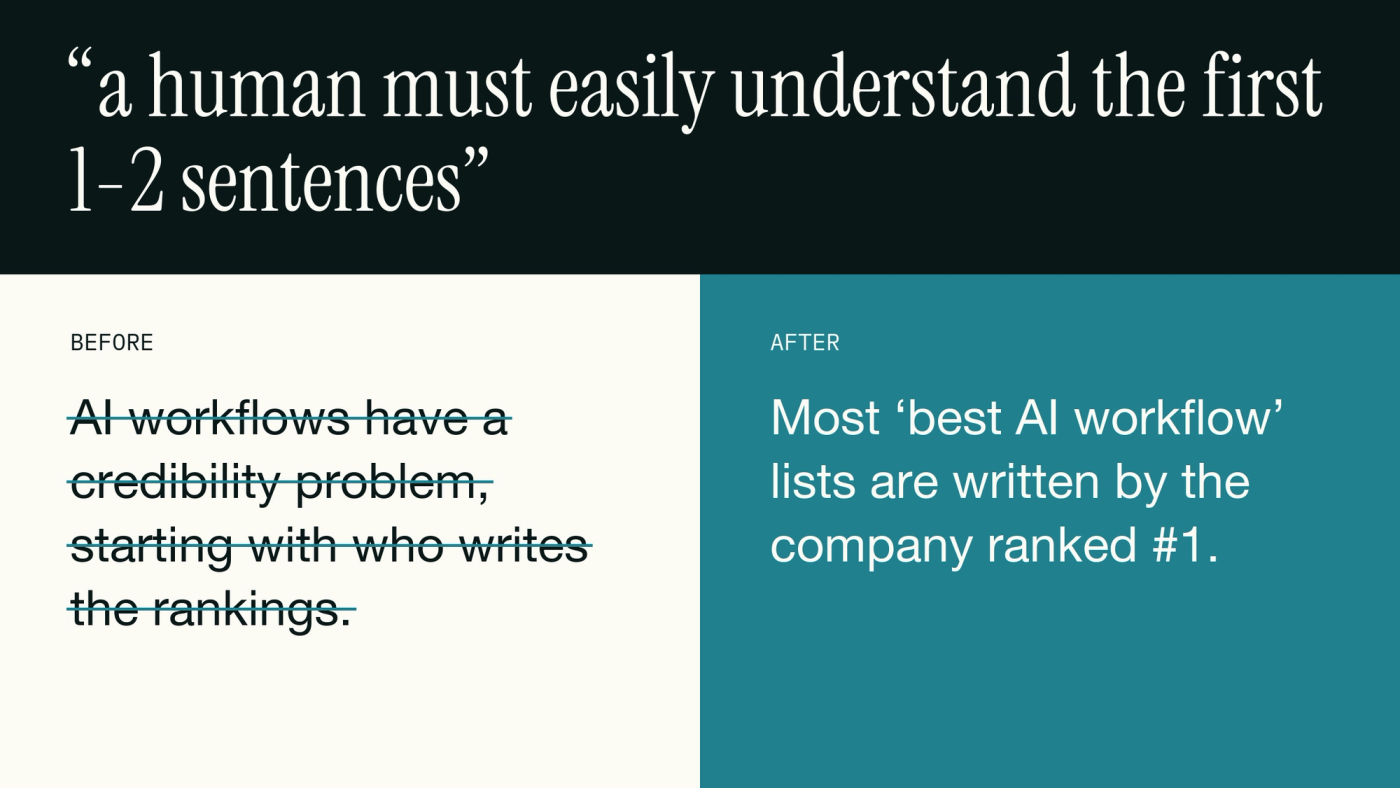
1. Setup instead of landing
The learning: land on first read. Nothing abstract goes in front of the concrete fact. “Credibility problem” is a category; the fact is who writes the list.
2. A statement with no tension
The learning: a hook needs tension or a question, not a tidy comparison. Ask the question the reader is already annoyed about and they read on.
3. Thread openers that tease
The learning: the first tweet states the payoff, what the reader gets and how many. A tease loses a reader who only sees one line before they scroll on.
4. Video text that explains the video
The learning: video text has one job, which is to make someone press play. Anything that explains the video is doing the video's job for it, and doing it worse.
5. A sample number instead of the rule
The learning: a sample number is one result; a rule covers every result. Put the rule in the title and it still holds a year later.
The Claude skill
The skill below is called hook-first. It lives at ~/.claude/skills/hook-first/SKILL.md and runs the same five checks on any opening line: a post, a thread, a caption, a headline, a subject line.
mkdir -p ~/.claude/skills/hook-first
# paste the SKILL.md below into ~/.claude/skills/hook-first/SKILL.md
# then in Claude Code: /hook-first  (or just ask it to draft; the description triggers it)
---
name: hook-first
description: Use when writing or reviewing the first line of any post, thread, carousel, caption, headline or email subject. Rewrites the opener for a reader with severe attention deficit. Triggers on hook, opener, first line, headline, thread, caption, subject line.
---
# hook-first
Write or rewrite the opening line, then run the self-check. Return the hook, then one line saying which rule it uses.
## Rules
1. Land on first read. The first one or two sentences must be understood by a stranger with no context and no attention. No abstract noun before the concrete fact ("credibility problem", "landscape", "in today's world" are banned openers).
2. Create tension or ask a question. Ask the question the reader already has, or make a claim someone would argue with. A tidy statement is not a hook.
3. Openers state the payoff. For threads and carousels: what the reader gets and how many ("5 AI content mistakes, and the skill that fixes each"). Never tease.
4. Video text is a hook only. One line that makes someone press play. No explanation of what the video shows.
5. Rule over sample number. "10% of what they pay, every month for a year" beats "Earn £[amount]". If a number is a sample, replace it with the rule that produced it.
## Self-check
- Cover everything except the first line: does it tell the reader what they get?
- Does the first line name its subject (no "this", "it", "they" without an antecedent)?
- Is there a question, a number or a claim someone would push back on?
- Could a 12-year-old repeat the line after one read?
- Zero banned openers, zero em dashes.
Run it on the last thing you published.
Where this leaves you
A hook is not decoration. It is the only sentence guaranteed to be read, so it carries the whole job of getting to the second one. Fix the five patterns above and most of your hooks stop needing a rewrite. When the copy is ready, schedule it from Voholabs Studio, the free scheduler we built for this.
Frequently asked questions
- What makes a good hook, and how does it fit into AI content skills?A good hook is understood on the first read and makes a stranger want the second sentence. It names its subject and carries a question or a claim someone would argue with. That is the first of the AI content skills this series covers: the first line an AI writes is usually the first thing worth fixing.
- Should an X thread's first tweet give away the answer?Yes. State what the reader gets and how many. A reader with no attention only sees the first tweet before they decide whether to open the thread, so a tease loses them before the payoff arrives.
- How long should a hook be?One sentence, two at most. The test is not length, it is understanding: could a stranger repeat back what they get after reading it once.
Sources
- Agent Skills overview· Anthropic
- Creating helpful, reliable, people-first content· Google Search Central